Showing posts with label apps. Show all posts

Tuesday, April 8, 2014

Only One App Is FTL: Faster Than Light

FTL Ship
With the Rebel fleet following close behind them, the crew of The Krestral must navigate their ship across several unfriendly sectors of the universe with a message that could save the Federation from certain doom. All three of the initial crew have names and the vaguest of identities, but that is ridiculously unimportant.

Most of them, if not all of them, are going to die. And when you are done staring blankly at the lifeless hull of your spaceship drifting in space or the flaming wreckage left behind by pirates, an entirely new crew will be randomly generated to begin the mission anew. Their chances to survive aren't any better.

Since every encounter is randomly generated, there is nothing to remember, repeat until you active perfection, or attempt to work around. It's an exceptional exploration against the clock game that plays as fresh the first time as it does the tenth time.

Faster Than Light plays like a native on the iPad. 

The Krestral begins as a stripped ship with light armaments. Its laser mostly relies on the same energy that powers the shields, engines, sick bay and life support. And while Artemis missiles require less energy to launch at a hostile ship, they are considerably more finite and hard to come by.

There are other ship systems to keep on an eye on too. Someone has to be stationed on the bridge so the ship can jump from one waypoint to another. Working sensors are critical to keep abreast of everything from bow to stern. And the ability to remotely open doors remains the best method of fire suppression.


During firefights, losing even one or two systems can be painful if not fatal. And since the battles play out in real time, players must use their limited crew members to balance conflicting priorities at best or sacrifice them at worst.

The space opera is alive and well with Faster Than Light. 

With permanent death (permadeath) at its core, the developers have done gaming a great justice in adding a layer of urgency to the experience. It creates an incentive to explore as much of each sector as possible despite the time pressure, leveling up the crew and upgrading ship systems in preparation for an increasingly dangerous onslaught of threats.

While many of them will become familiar — infected space stations in need of assistance, derelict spaceships that serve as decoys for private, well-armed rebel patrol ships on a perimeter search — all of them play out remarkably different. Yes, the mechanics are fundamentally the same but not the cosmetics. More than anything else, it's these subtle changes that make every encounter engaging and unexpected.

A couple graphs about the developers. 

Justin Ma and Matthew Davis Three years ago, artist-designer Justin Ma and programmer-designer Matthew Davis left the safety and security of an established game developer. They wanted to create something they could stand behind.

Inspired mostly by the storyline of Firefly, simplicity of Spelunky, and several imagination-based board games, the duo took a year off to create a singular-player spaceship simulation game. The result was a scrappy and roguish indie game that needed about $10,000 to finish the beta work, cover some business start-up costs, and pay their sound designer.

They raised $200,000 instead and the space opera game Faster Than Light went on to win several indie game awards and capture critical praise from a number of reviewers. Plenty of developers would have been satisfied with the initial success and dashed off to make new games. So far, Davis and Ma have mostly doubled down and migrated the entire game to the iOS platform.

FTL: Faster Than Light Jumps 8.1 On The Liquid Hip Richer Scale. 

Although not as epic as Star Command, which resembles Star Trek more than Firefly, Faster Than Light is a surprisingly detailed yet straightforward space game that accomplishes everything it set out to do. It is mildly nerve wracking and immeasurably fun to hold the fate of the universe in brisk 30- to 90- minute segments. There is also a certain freedom with the linear trappings of a tight storyline.

FTL: Faster Than Light is now available for the iPad. The new interface is right in line with the desktop, even though it is played at a noticeably slower pace. The tap-tap-tap elements of the game also take some getting used to but the learning curve is relatively quick. You can also download the original FTL: Faster Than Light [Desktop] version from Amazon.

Wednesday, December 11, 2013

The Wolf Among Us Is Folklore Noir

If you like fairy tales that are black and seedy, nothing else compares to the recasting of the Vertigo comic series Fables. It's an interactive episodic story that retains the intrigue of, but breaks away from zombies, last year's serial interactive game The Walking Dead.

While The Walking Dead is still very much alive with Telltale Games set to release a second season for iOS fans (console gamers are already playing), there is a new sheriff in town thanks to The Wolf Among Us. His name is Bigby Wolf and his town is the Big Apple.

He doesn't police the entire city, mind you. His jurisdiction is largely confined to the back alleys and broken down buildings where fables go about their daily lives. None of them live happily ever after.

The Wolf Among Us from Telltale is all hard boiled. 

No, these are not the fables you are told as children. Any reasonably innocent veneers that might have been sported in their original stories are stripped away. The content is more mature.

The oldest brother from the Three Little Pigs mooches bourbon. The Woodsman who saved Snow White goes on benders. One of the flying monkeys from the Wizard Of Oz would rather slug down wine than get the job done. And your perspective? You play as the infamous Big Bad Wolf.


It's his job to somehow keep the peace as fables, fairy tales, and legends eek out a living in our world. Most of them exist in Fabletown, a sizable chunk of New York City. The fables themselves blend into the backdrop, using an enchantment called Glamour to make those that aren't human look human.

The last thing they want is to draw attention to themselves. They would rather humans (a.k.a. the mundane or mundys) not know that they escaped their home worlds to live here in exile. To help keep such order, Ichabod Crane serves as Deputy Mayor. Snow White is his assistant.

And then there is Bigby. He is a natural fit as sheriff for his preternaturally powerful senses. But there were several trade offs. Not all of the fables and fairy tales trust him.

They don't always believe that Bigby has overcome his dark past — even if they all agreed to start with a clean slate. Why would they? Most of them have already mucked up their reputations, finding it is easier to be bad than good in their new and marginal lives.

The back story comes from the head of Bill Willingham.

The original series source material was published in 2002 and based on a premise crafted by Bill Willingham. His story takes place after most characters from folklore and fairy tales are ousted from their homelands by a conquering force called The Adversary. Without homes, they found refuge in our world and then attempted to blend in.

Willingham originally received his break as a graphic artist and storyteller in the late 1970s. He worked for TSR, Inc. as a staff artist. Later, he gained attention in the comic world with his series Elementals, which was published by Comico.

Another quick graph or two to cover the game play. 

While the game play is very similar to The Walking Dead, there are some differences. The most compelling includes Telltale Games' continued attempt to break away from the linear nature of storytelling games. In this case, not only does what you do make a difference, but also when you do it.

Another significant change is the underlying psychological objective of the game. Whereas The Walking Dead often presented moral challenegs, The Wolf Among Us seems to balance itself between being a loner or part of a social group as Bigby solves a murder mystery.

The Wolf Among Us Transforms 7.8 On The Liquid Hip Richter Scale. 

While the first episode might seem short in terms of the game play, Telltale Games does a phenomenal job at moving interactive game stories forward. The illustrative work, story lines, and increasing adaptability to players choices continues to be outstanding.

For portable iOS platforms, The Wolf Among Us is compatible with iPad 2, iPhone 4S, and iOS 6. You can find all of the console and software offerings on Amazon (digital codes). Most players consider it a worthy successor to The Walking Dead. Not everyone appreciates the niche, but there is no question that Telltale has found a future in adapting graphic novels.

Tuesday, October 8, 2013

Two Pandemics Ahead Of Halloween

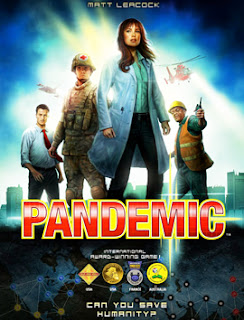
Pandemic for iOS
While zombies had a hand in making apocalypses popular, the Walking Dead didn't do it alone. Depending on how one adjusts the lens, zombie stories punctuate different fears at the micro, median and macro levels.

At the micro level, people worry about their ability to make the right choices. At the median level, they worry about the societal allegories mastered by people like George Romero. And at the macro level, we worry about the real possibility of a pandemic. Just ahead of Halloween, the latter has a new addition.

Two mobile games with a global view of pandemics.

While there are other games on the market, the two smartest pandemic games out are Plague Inc. and Pandemic. Each puts its own spin on the problem, with Plague Inc. inviting you to play as the infection and the board-ported Pandemic offering up a pass-and-play game to cure four diseases.

Both sound more grisly than they actually are, unless you invest in imagining the catastrophic effects of game play. There aren't any overtly disturbing graphics for either high stakes game. Both are played from a global perspective, with the catastrophes playing out on a city or country scale.

A quick recap of what makes Plague Inc. compelling.

Plague Inc.
Plague Inc. has captured plenty of attention since being released a couple of years ago. In fact, earlier this year, the Centers for Disease Control and Prevention (CDC) even invited the founder of Plague Inc. makers Ndemic Creations to speak to the staff. The CDC has become increasingly interested in the game as a tool to teach the public about outbreaks and disease transmission. It even gave Ndemic Creations some tips.

What makes Plague Inc. compelling is its realistic qualities, which game creator and founder James Vaughan attributes to his focus on "infection cycle" mechanics. The infection cycle dictates how people become infected as well as the basic reproduction rate of the pathogen someone is playing.

It's these qualities that help the game remain fresh after hours of play. There are several different kinds of pathogens to change things up: bacteria, virus, fungus, parasite, prion, nano-virus, bio weapon, and the new Neurax Worm and Necroa Virus.

While all of them have similarities, each requires a different balancing act to successfully eliminate humans from the planet. To add even more angst to the mission, game play is a real-time race against the clock. The pace steadily increases as the pathogen moves from being unnoticed to a global threat.

The key to the game is finding the right balance for each pathogen. If the disease is too gruesome, then countries will work harder to cure it. If it is too lethal, it could kill anyone infected before they infect other people. If the threat is noticed too soon, airports will close and borders will be shut down. Iceland never looked better as a place to live as it does in this game.

Pandemic swaps your place in the race for a cure. 

Pandemic
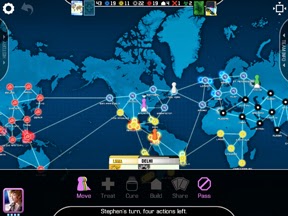
Recently board-ported to tablets, Pandemic is a turn-based strategy game that can be played alone or with up to four pass-and-play participants. While sparing players from any pathogen details, the action commences with the spontaneous eruption of four diseases in different areas of the globe.

The player (or players) must then use four specialists (from a pool of seven) to find cures before it is too late. Cooperation is especially important as each specialist has unique skills that will ideally help the team effort.

Even so, Pandemic isn't easy. The game becomes increasingly challenging as the specialists are overrun by pathogens designed to spread faster than they can be treated. Specifically, there is only one way to win, but there are several ways to lose. Even if you manage to keep the diseases in check, game developer Matt Leacock built in time limits (drawable cards), event limits (outbreak limits) and singular disease maximums (spread limits).

To win, players must globe trot around the world, treating infected populations until they amass enough cards to cure a disease a research center built several turns before. Making matters more challenging, it's common for one specialist to be holding the last piece of an equation but almost impossible to pass on the knowledge.

Plague Inc. Edges Out Pandemic At 8.2 On The Liquid Hip Richter Scale. 

Although players eventually discover that there is one primary objective to almost every scenario, Plague Inc. still creates a level of fun intensity that most strategy games never achieve. It really is a well thought out game.

The newer addition to this genre, Pandemic, is still fresh with a respectable 6.4. It's fun, but in a very different way that sometimes feels less strategic and more left up to chance. A multiplayer option, as opposed to pass-and-play alone, would have given the game another boost.

You can find Pandemic: The Board Game by Z-Man Games (and F2Z Digital Media) and Plague Inc. for the iPad on Apple. Plague Inc. can also be played on an iPhone. The Pandemic board game can be found on Amazon, along with expansions such as Pandemic: In The Lab Expansion Game. Anyone who enjoyed the board game will find it plays much the same way without having to clean up (even if digital can't truly replace the real thing).

Wednesday, June 12, 2013

Warhammer Quest Takes A Game Turn

While Baldur's Gate: Enhanced Edition left some people wondering why anyone would ever create a classic turn-based role playing tabletop game without overcomplicating everything, along comes Warhammer Quest. It delivers Dungeons & Dragons style play better than any app before it.

Although role playing is naturally limited — making the game more akin to a turn-based dungeon crawl (a.k.a. hack-and-slash campaign) — Warhammer Quest does exactly what it sets out to do. It allows you to lead a party of four pre-generated characters on a series of loosely-tied dungeon adventures.

Warhammer Quest works as an interactive story, with you playing every player. 

The party consists of the proverbial troupe made famous by Lord Of The Rings: marauder (fighter), elf (archer), dwarf (fighter), and wizard. There are three additional characters that can be purchased, including classic Warhammer-like characters such as a troll slayer dwarf, warrior priest, and archmage elf. Although the additional character packs are steep, the game is tooled for future character packs too.

The important thing to know here is that while a large party can travel from town to town together, only four find themselves on a quest or adventure at a time. So unless you plan to ignore one of the original four outright, characters will have to be rotated into alternating quests in order to keep them relatively close in level, something that is challenging even if they journey together.

While the characters do place treasure, artifacts, weapons, and armor in a community pool (unless they possess the item), experience is tallied on individual merit with an unfair advantage of last hit being awarded the kill. The point is that every character needs to get their hands dirty to progress.

A quick overview of a turn-based, semi-strategy game. 

The game is mostly broken into three play areas: towns, dungeons and the map. Towns (and cities) are where the party can sell and purchase goods, level up, pray to their patron, and find quests that are tied to a larger overarching story of sorts. Dungeons (and quests) are located around the city, usually consisting of missions (rescues and assassinations), quests (find specific treasure), and arch stories.

The map is how the party navigates between the other two play areas. If they are starting in a town or city, for example, every quest marker within their immediate proximity will be available. Sometimes something might happen on the road, but those stories are mostly scripted content and not real action.


The skirmish elements take place in dungeons and on quests (which are also dungeons with different goals). Much like the board game that Rodeo Games ported into an app, the battle area is a dungeon grid. Characters move to engage monsters, use items or cast spells. Spell casting can be a mixed blessing. Characters within the spell radius can and will be injured by friendly fire. Wild swings can cause damage too. And some characters don't fight well in a crowd, occasionally becoming pinned.

Once you kill all the monsters (orcs, goblins, trolls, etc.), the party collects any loot or artifacts before moving on to the next encounter. It's surprisingly fun, even if turn based means a slower paced game.

What Warhammer Quest currently lacks are any point-and-click search points in the richly rendered landscapes. As far as anyone can tell to date, there are no secret doors or non-combatant encounters.

A little bit about the development team at Rodeo Games. 

The basic game play concept not only comes from Warhammer Quest, but also the perfection of a platform designed for a different franchise. Rodeo Games developed a space story franchise called Hunters and Hunters 2. Hunters 2 has a similar play style as well as some fun customization. The attention to detail is apparent in all their work.

The development team came together specifically to make iOS games in their Guildford, Surrey studio, which is located in the United Kingdom. The developers have worked for a few large-scale projects, ranging from Criterion Games and Lionhead Studios to EA Games and BodyCount.

Warhammer Quest By Rodeo Games Grinds 8.5 On The Liquid Hip Richter Scale. 

Rodeo Games has been known to work diligently at producing additional content for the games it creates, which keeps everything fresh for nominal support. The game already has an expansion pack.

Overall, Rodeo Games has set a new bar. And after talking it over with my editor, there isn't too much that can be improved. A few long-term suggestions might include modest customization for characters (especially names), findable loot (as opposed to automatic awards), secret doors, traps and locks for thieves, etc. And, of course, if they are ever able to port characters or play parties made up of multiple iPad players (especially those entering lightly custom dungeons), they might have a serious run on paper games too.

Warhammer Quest is only available from the iTunes App Store. The initial game is $4.99 and well worth it. While there are in-game purchases and warrior packs, the initial game is immersive, offering plenty of play time. Visit Rodeo Games for more intel.

Monday, May 27, 2013

Contour ROAM 2 Makes For Video Fun

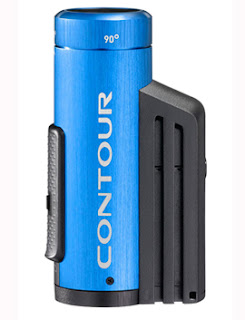
Contour Roam 2
While some people are still looking for Google Glass to be the revolutionary hands-free video camera, the innovation already exists. It's much more durable and versatile too because you don't need glasses.

While there is already a more advanced version on the market, the Contour ROAM 2 I own captures crystal clear high definition video footage and 5 MP still photos. The battery specs are impressive, with about 3.5 hours of battery life and an instant-on record switch to maximize it. 

So why haven't more people embraced the Contour camera? It mostly has to do with the way it is marketed. It originated as an adventure and extreme sports helmet mount video camera, but has become much more versatile as an everyday cam as long as you don't mind waiting to see the shot.

If you want to see the shot, you have to upgrade to Contour +2, something I don't own but have seen in action. The viewfinder relies on Bluetooth connectivity to a smart phone, which is still a bit hit and miss. It's something I'll circle back around to cover later in the review. The focus here is on what I own.

Designed for action enthusiasts, but fun for anyone with a little creativity. 

Although the Contour ROAM 2 bills itself as a hands-free camera, which it is, it can also be turned into a held held by attaching a hand grip (a.k.a.pistol grip) to the the tripod mount. With a little practice, it's easy enough to learn how to frame up your shots without a viewfinder (or use the laser alignment).

Most people, of course, don't buy the Contour ROAM 2 for handheld functionality. Most are interested in the mounts, specifically helmet mounts. Once the mount is attached, usually with adhesive tape, the camera slides right into place. It also pays to add a tether in case the mount comes off. 

Helmets aren't the only place to add the camera. They can be added to almost anything, including surfboards, which is why I picked one up. While I wouldn't keep it submerged for any length of time, the camera is waterproof up to one meter without an additional casing. Waterproof housing will extend that depth to 60 meters. One of the more creative promo videos adds in some fun.


Contour collects hundreds of videos with vignettes of what's possible with the camera. And although I know many people attempt to compare the Contour and GoPro, they really are two different kinds of cameras, with the Contour's minimalistic bullet shape giving it a slight edge despite the slightly better vid quality most associate with the GoPro. 

For example, although it's not the most comfortable shooting solution, Contour even makes a headband that you can use as a camera mount. And the headband doesn't even come close to the extent of mounting solutions that the bullet shape offers. It's also the tougher construction, in my opinion. I've seen one dragged from behind a motorcycle that survived with relatively little road rash.

Contour
There are plenty of places Contour can improve its offerings. 

The most frustrating aspect of the Contour ROAM 2 was learning that it isn't Bluetooth ready, which makes the Connect app released for the iPhone and Android useless. You need to invest twice as much for the Contour+ 2 to pick up what seems increasingly important to plenty of people.

As mentioned earlier, it's not the viewfinder that makes people want the Connect app to work better than it does, it's the ability to change settings. Once you set the Contour ROAM 2, you're stuck with the setting until you connect to your computer again. It's inconvenient, but not as bad as some people make it out to be. 

The Contour ROAM 2 Snaps 6.5 On The Liquid Hip Richter Scale. 

The biggest thing I can say about hands-free and viewer-less cameras is that you stay connected to the action instead of the screen. Sometimes getting the perfect shot gets in the way of real life. The Contour, whether you have a ROAM 2 or invest in a Contour +2, makes video fun again because you don't have to think about it. Go. Do. Record. And play it back later. If you don't like the shot, go do it again. 

You can find the Contour ROAM2 Waterproof Video Camera and Contour +2 on Amazon. The Contour ROAM 2 also comes in black, red, green, and blue. For more tech specs, visit the site. Visit the iTunes App store for Connect if you already own Contour +2. Check the requirements and for the latest update information; the app is free. 

Wednesday, April 17, 2013

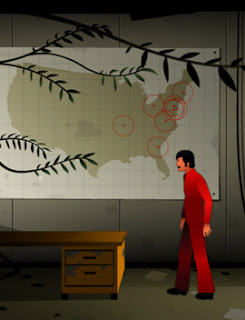
The Silent Age Is A Time Warp Story

The Silent Age
Almost immediately after it came out, we found ourselves sucked into the immersive and mostly flattened world that makes up The Silent Age. Stylish and straightforward, this free episodic story-based game with a time travel twist delivers a surprisingly addictive plot.

The nostalgic element of the game has everything to do with its setting. It's 1972 and change is in the air. This weighs both figuratively and literally on a janitor named Joe, a hypothetical everyman with a mustache who is handed a portable time travel device. It shifts between two times: his present and some well-weathered point in the near future after civilization came to a reasonably abrupt stopped.

Playing in two times gives the game legs. 

Although the puzzle of the game is relatively simple and surprisingly linear, forcing Joe to find and use various tools in a linear cluster (e.g., you can't find a tool in a room that hasn't been unlocked by a key someplace else), the writing and design saves this gem from obscurity. It's creative. And that counts.

There is an unquestionable enjoyment in discovery. For example, a random plant in 1972 grows to block a door in the desolate setting of 2012. The man you passed on a table is reduced to dust and bones, exactly the way he was left for dead a long ago (or in the very near future). So it's all up to Joe to navigate this crazy obstacle course with near average intelligence (or slightly brighter depending on you).


The trick is, of course, to toggle between times and use each to its advantage. A plant, for example, killed four decades ago won't ever grow to wild proportions and block a door. A locked door can't slow anyone down if the walls have collapsed around it. An orange jumpsuit worn by a time traveler remains suspiciously nondescript, mostly to remind Joe (and you) that the fate of humankind has fallen to a chronic underachiever who wasn't even given more clearance until his predecessor met his demise.

The Silent Age falls somewhere between campy and spooky. 

While it might be more fun to have even more interaction in the environment, the game developers seemed to have kept the game play straightforward on purpose. Rarely will anyone become stumped at the successively and lightly progressive challenges that keep getting thrown in Joe's way.

The benefit in keeping it simple is that The Silent Age pace remains largely seamless for the story. Joe never knows exactly what is happening but always has a sense of what needs to happen next. This creates a compulsion to play through with curiosity and will make some people crazy because episode two is not complete.

In order to make the game a labor of love fueled by passion instead of cash, the game developers are asking for donations of $25,000 to complete episode two. Once they do, those who helped out will get the game for free. Everyone else will have the option to buy. Think of it as reverse crowdsourcing as the developers want to reach a no-risk threshold before they give up the goods (which are, at least, party done).

A few words about the indie developers who designed it. 

House On Fire
The game was created by an indie developer based in Copenhagen. It mostly consists of a team of six, with programmer Linda Randazzo, game designer Thomas Ryder, and production manager Uni Dahl (who also programs from time to time). They originally came together to create a different game, Neon Zone, but then became immersed into this alternative universe instead.

Episode two, they say, will also be the final installment. The development team wants to keep the game straightforward without too many extensions. Some players might have feelings about the news, given the expressionless Joe has a significant amount of character. Maybe it's the mustache, originally meant as a Facebook joke for the Movember Moment until fans picked it over a clean shaven hero.

The Silent Age Shakes Up Time At 7.2 On The Liquid Hip Richter Scale. 

If the puzzles weren't so easy and the linear controls not so confining, possibly even alternating outcomes like The Walking Dead, the game would score even higher. But even as it stands, The Silent Age with its stylish throwback graphics and clever storyline is well worth the the investment. It's especially promising as something opens up Pandora's box for more time travel games in the future (or maybe the past).

The Silent Age is currently available from iTunes for iOS devices such as the iPhone and iPad. However, plans are in the works to release the game for the Android too. The company, House On Fire, is very adept at communication through its social media channels. Visit them on Facebook.

Tuesday, April 9, 2013

Art Exhibits High At The Getty Center

The Getty by Richard R. Becker
Rising high above the Los Angeles skyline in Brentwood is a museum with one of the most impressive art collections anywhere. To get there, guests are asked to leave their vehicles behind and catch the three-car cable pulled tram that ascends and descends the hill every day. The winding route takes five minutes.

Almost 1.3 million people take the journey every year to see one of the finest collections of pre-20th century and 20th century European and American art. Housed in five exhibition pavilions that make up the campus, the Getty Center itself is a work of art, meticulously designed by architect Richard Meier.

Meier took special care in considering how people would arrive and orient themselves. The museum itself extends south along one of two ridges that converge to make up the campus. Once they arrive, they have an immediate choice to explore the grounds or enter the museum through the three-story cylindrical lobby that opens onto the museum courtyard, which is surrounded by those buildings.

"Not all those who wander are lost." — J.R.R. Tolkien

Although not written for the Getty Center, the timeless Tolkien quote conveys the right sentiment. This is the kind of place to wander for hours and lose yourself despite never being lost. Around each and every corner of every circling pavilion, the work of master artists, painters, artisans, and craftsmen are everywhere, usually with statues and artifacts on the first floors and paintings on the second floors.

Inside The Getty by Richard R. BeckerWith many beginning in the North Pavilion, guests will find art, sculptures, and illuminated manuscripts. The majority of the collection in this pavilion pre-dates 1700, with an emphasis on medieval art. After transversing the lower and upper levels, a sky bridge connects the North and East pavilions.

It is in the East Pavilion where visitors will find increasingly familiar artists, with Dutch, French, Flemish, and Spanish paintings as well as sculpture and Italian decorative arts dating from 1600 to 1800. The highlight of the collection, however, is the 17th century Baroque art.

Immediately between these buildings and easily missed while wondering into the South Pavilion is a small standalone building that holds what the Getty Center calls The Family Room on the first floor. It is one of several places where the Getty lives up to its mission to inspire curiosity about the visual arts, inviting younger visitors to construct their own interpretation of an illuminated manuscript, build tube structures, and enjoy treasure hunts.

The Getty Museum is evolving on site and off site with apps.

Further back, however, is another Getty Center rarity. The South Pavilion contains the museum's 18th century paintings and a majority of the museum's European decorative arts collection. What makes the collection especially interesting is that some of the exhibits are done up in finished rooms, elaborately furnished and paneled.

Getty App
It was one of the Getty Center's interactive exhibits that inspired The Life Of Art, an iPhone application that details how four decorative works maintained at the museum came together, with various artisans each adding their expertise to create the elaborate furnishings. The app, much like the exhibit, includes a lidded bowl, silver fountain, side chair, and wall light.

The application isn't exclusive. The J. Paul Getty Trust has produced other free apps, including one to coincide with its exhibit Florence At The Dawn of Renaissance. The visiting exhibit is tied to how Florence flourished in the 1300s and helped set the stage for the Renaissance.

In addition to its own apps, other developers have created some.

In keeping with the desire to inspire, several other apps have been undertaken by other developers. In 2001, Toura created an app that featured highlights from four exhibits. And another by the same developer features 150 stunning works at the collection. It is the only one that requires a purchase, but does include some of the famed paintings from the West Pavilion, including Van Gogh.

Chicken by Richard R. Becker
Even more remarkable is the museum's recent exhibit on Pinterest, with almost 1,700 works. Still, even if these drawings, paintings, and photographs capture representations of the work, there is nothing like the real thing. The fountains, architecture, cactus garden, and central garden designed by artist Robert Irwin all converge to transport anyone away from Los Angeles for a few hours or even a day.

The Getty has several options for eating. In addition to light fare snack carts, the center has a restaurant and semi self-serve cafe (pizza oven and hamburger/chicken grille). While the restaurant menu seems pricey at a glance, the preparation and presentation is exquisite, as fine as any leading Los Angeles eatery. Plan to eat in, with dinner equally distinguished.

The Getty Center In Los Angeles Rises To 9.9 On The Liquid Hip Richter Scale. 

The Getty Center and Getty Museum has been a favored place to visit in Los Angeles since it opened. Given the museum waives its admission like several Los Angeles museums and art galleries (there is a modest $15 for parking), there really isn't any reason to miss it.

For a complete overview of travel accommodations in Los Angeles, compare top travel deals at Expedia.com. The Getty is especially close to Santa Monica (and you can avoid any highways). For a virtual tour of the Getty, you can find The Life Of Art, Getty Museum HighlightsFlorence At The Dawn of Renaissance, and Pacific Standard Time on iTunes. Three of the apps are free.

Monday, March 4, 2013

Real Racing Revs A Competitive Edge

Real Racing 3
Not everyone was thrilled when Electronic Arts (EA) swooped in to acquire Firemint, a developer that found its Real Racing series frequently outpaced EA's Hot Pursuit series as one of the most loved racers on handhelds. Most people were afraid that the beauty of Real Racing would quickly disappear.

It didn't, mostly. What EA did instead was merge Firemint with Iron Monkey to make Firemonkeys, the new Australia development team responsible for creating the first free-to-play entry in the Real Racing line. Real Racing 3 is an entertaining addition, even with the introduction of new in-game economics, time delay deliveries and repairs, and semi-real friend competition.

Maybe it's best to get the setbacks out of the way.

There have always been two sides to the freemium business model sported by some handheld games. Some people loudly hate it. Some people quietly love it. And the reception that freemium software developers experience is always a crap shoot — wildly successful or painfully short-lived.

Here's the reality of it. On any given day, most of the top ten grossing apps on Google Play and in Apple's Appstore are freemium games. So despite pushback against the concept, too many people are willing to shell out $100 for in-game purchases (or more), even if a paid version valuation of the same game (no in-game purchases) is probably less than $10.

Although many Real Racing fans would prefer a one-time premium game price as opposed to freemium, EA makes a genuine effort to strike the middle ground. It's possible to play EA freemium Real Racing 3 without having to make in-game purchases if you are willing to progress at a less than prideful pace. Not all developers are nearly fair; most make in-game purchases semi-mandatory.

In this case, in-game economics drive the decision. After any given race, drivers will have to use some of their winnings to maintain and improve their vehicles. This includes repairs for damages that occur during the race, routine maintenance like oil changes and new tires, and upgrades to gain an edge.


None of the game economics are unreasonable (especially if players are smart about it), making the free play possible. What might be a little less appreciated is the real-time waiting periods for upgrades and services (incidental repairs are instant). You can spend gold, the game's second and harder-to-come by currency, to eliminate wait times. But if you do, you might be passing up other perks later in the game.

Finally, Real Racing 3 has the promise of real players via Apple's inventive asynchronous multiplayer mode. The time-shifted multiplayer feature allows one friend to race and challenge a second friend one day, and then allow the second friend the chance to race the next day. In other words, racers don't race their friends as much as they race friend "doubles" based on Game Center or Facebook friends who also own the game. It's almost cool, unless you want to race them in real time.

The allure of Real Racing 3 remains mostly the same. 

Although the review invests more room on the setbacks more than the successes, it's largely because the allure of Real Racing hasn't changed much. The beauty of the game has always been associated with its gorgeous design and an intuitive interface.

This time out, EA added additional high performance manufacturers —Audi, Bugatti, Lamborghini, and Porsche — to create a slate of 46 race-worthy cars. As players progress and save some race winnings, they can purchase additional vehicles for their fleet.

Real Racing 3
All of the tracks are modeled after their real-life counterparts — places like Mazda Laguna Seca, Circuit de Spa-Francorchamps, Silverstone, Hockenhemring, Indianapolis, and others. While races can include an immersive 22-car grid, there are several race variations — a combination of styles developed by both development teams. They include drag races, head-to-head races, elimination rounds, fastest times, and fastest speeds.

If you aren't playing with friends, the game will select random players from the Game Center (or Facebook, if you connect the game to your social network) to act as clones. The players selected are generally picked because they are have comparative skills. The only downside is that EA games always gives players the last position in the race (as opposed to affording them qualifying times).

Real Racing 3 Speeds Ahead At 6.7 On The Liquid Hip Richter Scale. 

As far as play tips, always make repairs and take care of maintenance first. It's hard to finish in a paid position with a damaged car. As you accumulate more money, invest in upgrades to boost performance and avoid the temptation to waste gold on wait times.

Eventually, wait times won't matter because you will be able to toggle between cars. Likewise, don't count on upgrades to give you a maximum advantage. You'll have to drop some driver assists, allowing you to barrel through corners faster (among other things).

The bottom line? It's fun and free (unless you choose to fuel it). You can download Real Racing 3 from iTunes. You can also get exclusive deals at Origin powered by EA Games, including other race titles and console game releases. Worst case, you can always delete the game after a few races.

Tuesday, November 20, 2012

Digital Photos Take An Analog Turn

Photo To Art
Smart phones and digital photography may have revolutionized how people take pictures, but it hasn't changed how people want to see them. Passing around a smart phone or scrolling digital files isn't it.

People appreciate print. And print has taken on a new meaning in recent years. There are dozens of developers working to deliver more diversity in digital photo output. Several have caught our eye, but Art.com, which originally specialized in vintage art posters and prints, has developed one of the newest ready for review.

Photos [To] Art app is free. Ordering is optional.

The Photos [To] Art app is a first generation digital-to-print application for iPhone, iPad, and iPad smart phones. Call it "first generation" because it isn't perfect. It's a promising work in progress.

The application was designed specifically to help people print photos to canvas, wood, or poster prints. This concept isn't necessarily new, but the application simplifies the process because the photos can be uploaded directly from your phone from either your camera roll or Instagram account.

The prospect is promising, but there are limitations. Although the application supports a variety of sizes from 8"x10" to 20"x30", the size is dependent on the photo format and quality. The allure of printing Instagram photos, for example, is limited, typically rendered at 12"x12" or 16"x16", which is especially important to know if you are hoping to create a series of three or more photos of the same size.

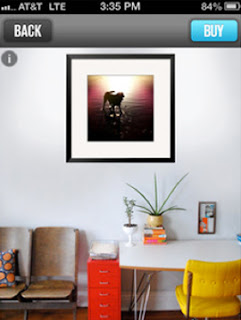
For more sizing options, the application prompts members to upload the shot from the camera roll (assuming the shot wasn't taken through the Instagram app). Most photos are then rendered at four or five sizes, with can be viewed against three mock living areas or on the actual wall where you intend to hang it. The latter feature is pretty clever, even approximating how far away you are from the wall.

Photo To Art
Although the limitations might seem annoying at first, it doesn't take long to adjust for output. The primary reason Art.com is a bit restrictive is because quality is the priority, especially with a 30-day satisfaction guarantee policy. For more flexibility, the web platform has some flexibility.

Specifically, the web platform provides some limited cropping and resizing (horizontal or vertical adjustments) options and allows you to save up to 10 photos for 30 days. In contrast, the application assumes all cropping is complete and saves only one photo at a time. It may also be possible to sync the mobile app with a web platform account, but I couldn't find it.

A few graphs about Art.com and its growing family of apps.

Lord of the Rings from Art.com
The Photos [To] Art app easily makes up for any limitations for ease of use and high quality outputs delivered, which has always been the objective of founders Michael Heinstein and Brandon Carr. They started with a single "poster" site concept and a small room in Berkeley, with nothing much more than a modest capital investment from the founders and a sympathetic relative.

Not even 15 years later, the rebranded Art.com and several sister sites have grown to become the largest poster and print producers in the world and includes one of the largest masters collections. They have developed two other apps: artMatch, which helps people find similar artistic styles by snapping a picture of any art; and artCircles, which is an iPad art curation tool that features artist picks along with any self-made collection.

More analog offerings from developers on the horizon.

The ability to order self-made prints from any mobile device is not an exclusive fix for analog. Three other projects in development that have caught our eye include the Impossible Instant Lab, which turns iPhone photos into instant Polaroids; Instacube, which ports photos directly from Instagram into digital frames; and Projecto, which transforms eight Instagram photos into a slide wheel that can be projected from a projector about the size of a matchbox. The latter concept convinced us to become a backer.

Photos [To] Art App By Art.com Prints 4.6 On The Liquid Hip Richter Scale. 

While Photo [To] Art has room for improvement, having personal photographs or artwork transferred to framed prints, wood mounts or canvas from a mobile app is a step in the right direction. Art.com keeps its pricing reasonable, with unmounted poster prints starting at under $4 (8"x10"). Canvas runs considerably higher, depending on size.

You can download Photo [To] Art from iTunes. The app has already been optimized for iPhone 5. It also works with iPhone 3GS or better as well as some iPods and iPads. The app is a free download, perfectly timed to take pictures over Thanksgiving with enough time to make prints for the holidays.

Wednesday, October 17, 2012

Reiner Knizia Adds A Tigris iOS Twist

Tigris And Euphrates
Two years ago, prolific board game designer Reiner Knizia released Samurai for the iOS, which remains one of the finest handheld device adaptions based on his games. Last year, his widely acclaimed strategy board game Tigris and Euphrates debuted with an equally beautiful design.

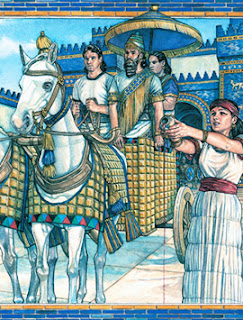
The game is named after the Tigris and Euphrates, two rivers that produced the Fertile Crescent and gave rise to what is commonly called the cradle of civilization in the Middle East. It was around this area that Mesopotamia supported some of the earliest urban settlements, which eventually included the Sumerian, Babylonian, Akkadian, and Assyrian empires.

What is the Tigris and Euphrates?

Tigris and Euphrates was one of the first games published by Knizia after he became a full-time professional game developer in 1997. Game play takes place on a map between and around the Tigris and Euphrates rivers at the dawn of civilization, with two to four players attempting to create a winning and lasting dynasty.

To do it, players draw and place tiles and leaders that represent various elements of civilizations — temples and priests (red), farms and farmers (blue), markets and merchants (green) and settlements and kings (black). With each turn, players attempt to expand their empires, represented by the Potter, Archer, Bull, and Lion.

The goal of the game is to develop four key aspects of civilization in the most balanced way possible, which includes part of the twist to one of Knizia's most popular games. The lowest scoring aspect — spiritual, agricultural, commerce, and government — will determine the winner, not the highest.

Tigris And Euphrates iOSIn addition to receiving victory points for possessing placed tiles connected by a leader, players can expedite the accumulation of victory points by collecting treasures, building monuments, and winning conflicts. Monuments deliver specific victory points during each turn of play (but leave kingdoms vulnerable to attack) while treasures serve as a wild victory point placed in their lowest scoring aspect.

Conflicts are the most strategic plays of the game. They arise any time a leader is placed in a kingdom with an existing leader of the same color (a revolt) or when two kingdoms with leaders are united. In addition to quickly expanding an empire, they effectively force the losing player to start over.

There are a few other nuanced features, such as catastrophe tiles, but the basics cover the general spirit of the game. Although it is similar to Samurai as a strategy-based tile game, most people consider this game Knizia's masterpiece. (Others might argue that he has had dozens.)

The brilliance of bringing the game to mobile devices.

Tigris and Euphrates always had a complex scoring system, which is alleviated by the computer taking over the role. Tallying victory points takes place in real time, allowing players to immediately recognize what aspects they need to shore up before the final rounds of the game. Likewise, any missed conflicts are immediately identified and reconciled.

Although the game might feel intimidating the first few times, the optional tutorial and pop-up tips not only teach you how to play, but also give you a good grasp of the strategy involved. There is even a hint feature against AIs if you feel especially lost. It helps diminish the learning curve.

Reiner Knizia
Most players will start playing against one to three AIs, which have slightly different personalities and adjustable difficulties. In lieu of the AIs, you can use the app as a pass-and-play game or look for friends and random strangers to play against.

As with many adapted board games, there is never a shortage of people (or AIs) to play against and never anything to set up or pick up after the game. Game play is relatively short, about 30 minutes (more or less) depending on how long you or other players take to move pieces. More experienced players might take longer.

Reiner Knizia's Tigris and Euphrates Captures 8.7 On The Liquid Hip Richter Scale.

Although most people will find Samurai easier to play, Tigris and Euphrates is the more engaging game. The game play is smart as a strategic and tactical game that relies on only a little luck (tile draws), providing an enjoyably complex game that feels deceptively simpler on the iPhone, iPod, and iPad. And graphics are adequate, blending the vintage qualities of the board game with the on-screen interface.

Kudos also goes to Codito Development and Sage Board Games, which rendered Tigris and Euphrates into an app. They have brought several boutique board games to market with the iPad in mind, including Knizia's Ra. It's a job well done, especially in that it changes the way people think about games.

You can find Tigris and Euphrates on the App Store via iTunes. Or, you can look for the out-of-print board game, last published by Mayfair Games, on Amazon. The Tigris and Euphrates board game includes a double scenario edition, which features a different map on the backside of the game board. The game is beautifully produced, with hundreds of painted wood pieces and illustrated tiles. (The top image is from the latest republishing.)

Wednesday, May 30, 2012

Autumn Dynasty Inks Beautiful Battles

There have been relatively few true real-time strategy (RTS) games developed for the iPad, but expect that to change soon. Autumn Dynasty is as playable as it is beautiful, setting a higher bar in the process.

Although the campaign play is woven together with a simple but intelligent storyline, the crux of the game by Touch Dimensions is a large scale real-time military combat simulator set in medieval Asia. Players command units of swordsmen, pikemen, archers, horsemen, calvary, and catapults while building an infrastructure (forts, camps, outposts, towers, and farms) to expand their growing military.

Anybody who has ever played any real-time strategy game ought to know the drill. Players want to build as much as possible, which aids in training a larger army. At the same time, it's likely they will have to defend their encampments against an increasing onslaught of enemy units.

There are four ways to play the game: campaign, skirmish, bluetooth (iPad vs. iPad), and online. No matter which game play you pick, there is considerable attention to detail. It ranges from the storyline of a campaign to the single-player skirmishes that allow for one of three different artificial intelligence (AI) opponents.

The artistic stylings of Autumn Dynasty makes it a standout game.

Most real-time strategy games have to balance speed and art. Autumn Dynasty doesn't have to. By choosing a visually appealing minimalistic design, the game looks great without sacrificing speed.

It plays out on a landscape that carries the simple but striking look of a Chinese ink wash painting, a timeless technique dating back to 600 A.D. The environment looks like it was inked and painted on parchment. The various units are simple while showing off some tiny, well-designed brushstrokes.

The best part of the art is that it goes beyond merely mimicking the look of an ink wash painting. The entire goal of ink wash painting is to capture the soul of whatever is being reproduced. And as units are directed with the graceful lines of touchscreen orders, they do seem to come to life on the screen.


The design and movements of the units and look of the buildings also make it even easier to forget that the game itself is based largely on rock-paper-scissors behind-the-scenes game play. It feels like playing a piece of history. Of course, there are other variables thrown into the mix.

Called doctrines, Autumn Dynasty adds variables that include special training for each unit: improved equipment, building enhancements, special skills, and elemental magic. Each doctrine has numerous abilities and three tiers in each to provide units and buildings with more and more power.

Making minute-to-minute decisions on whether to build, research, or train more units (and what kinds) is especially challenging in the single-player skirmishes. Most players will want to start with the campaign mode because it is as much a general a tutorial as it is game play with a decent back story.

A small introduction to the campaign story of Autumn Dynasty. 

The storyline is straightforward but interesting enough to hold attention, even when it is drawn out during a few of the cut scene sections. (It can always be skipped too.)

The nutshell version is that peace in the ancient Empire is threatened by a growing divide between the North and South. Rumors of unrest have prompted the bureaucracy (made up of farmers, nobles, and soldiers) that runs the Empire to commission an investigation.

Then again, a looming civil war seems certain as the South has not paid its annual taxes. But nobody told Scholar Hsu, because he sets out to investigate on behalf of the North with nothing much more than a wagon.

You know what happens next. Like any RTS that begins this way, some campaign scenarios are meant to be lost to advance the story. In this case, being robbed helps Scholar Hsu meet General Li.

Mostly, protagonist Scholar Hsu (the player) is looked upon more and more like a leader (assuming the payer does well). Told primarily in a cut scene storyboard fashion, each captioned frame carries the theme of the ink brush art renderings forward, creating a very promising game experience. What isn't as straightforward is that it becomes increasingly obvious the developers built in a plot twist or two.

Autumn Dynasty For The iPad Renders 9.1 On The Liquid Hip Richter Scale. 

Touch Dimensions has created a painstakingly detailed and very playable game with enough variations to keep the story from becoming too tedious. The ink brush painting concept is perfect, not only because it fits in with the medieval Orient, but also because it provides just the right amount of detail. It's also obvious that the game was specifically designed for tablet play; mastering a few gestures is simple.

Touch Dimensions said its distributor, BulkyPix, will offer Autumn Dynasty at an introductory rate. Some people shy away from games priced at $5 or more, but this one is worth it if you like RTS games. The game was originally conceived in 2009, but dramatically improved with better unit graphics and the removal of the paint brush pointer.

Wednesday, April 4, 2012

Things Go Bump In The Dark Meadow

Even before you wake up in the abandoned hospital, Dark Meadow immediately establishes an atmosphere of dread. From a distance in the cut scenes, the sanatorium on the horizon stands silently in the background like so many of those built in the early 1900s to treat thousands of tuberculosis victims.

The map of the grounds reveals some of its twisted history too. Some of it resembles a hospital. Some of it resembles a psychiatric ward. Some of it resembles an elementary school, even though you know the classrooms were meant to help patients forget that their future was as bleak as the peeling wallpaper.

A dark and gripping storyline makes for a better play experience. 

When the original game came out last October, it had some mighty big shoes to fill. The game itself had borrowed heavily from Infinity Blade, thinly masked only by the game's first-person versus third-person point of view. When you're attacked, dodge left or right. When you want to attack, swipe, swipe, swipe.

Unlike Infinity Blade, however, which is a fun game for awhile, Dark Meadow has three advantages. Although more difficult to master, you can use ranged weapons (mostly crossbows) as your assailants approach. Most of them have ranged attacks too — nasty stuff they spit at you.

The second difference is the environment. It's richer and much more sinister, coming closer to the free movement found in games like Dead Space but with a Myst-like quality. It's very obvious that Phosphor Games Studio pushed iOS as much as it could with the Unreal Engine 3. The shadows, lighting, and artistic gloom make you want to look around.

Lastly, the voice acting of your elderly ally is convincing and mixed. He helps flesh out the storyline that can't be found on little bits of paper that litter the hospital. But more important than his little bits of dialogue are the the diversity of his lines. It never becomes too repetitive, even when you pay attention. At first, you won't want to listen too closely — until you realize any tips you get are worth their weight in gold.


The attention to detail reminds you that the developers care. The proved the point once again, which prompted this review. They released an expansion called Dark Meadow: The Pact, which came with new content and levels that expand upon the first installment. But what really stood out to me was that it was free.

Some of the new features include the long-awaited iPad retina support, faster travel warps, light bombs, and some expected new enemies, weapons, and environments. Some people might scoff at the offering, but those people must not know that many developers launch a sequel and leave the original buyers in a lurch to repurchase the entire game.

So they made it free for everyone (hoping to cash in on in-game goods). That doesn't mean the original owners lost their money. Instead, they receive a free premium pack that includes: health kits, bombs, sun coins, and gold. And, best of all, ad-free play from the onset.

One of the better additions is the world map. The hospital is not that big, but you always have the sense that you are lost rather than pulling it up on a browser. It's not perfect, but it is better than nothing.

A little bit about Phosphor Games for the curious. 

Phosphor Games came together after Midway Games (Mortal Combat, Pac-Man, Tron, etc.) was shuttered in 2009. But some of the Chicago-based developers didn't want to see their open-world, third-person superheroes game die (now called Project Awakened). So, they acquired the rights and formed the company.

Since then, they've redeveloped that game while simultaneously launching Kinect Adventures (five adventures for Kinect) and Dark Meadow. Most of their efforts seem to be focused on the latter. Project Awakened is still waiting for a ship date.

Another cool coincidence about Dark Meadow is that there is a real sanatorium that resembles the game hospital, Montclair. We found a picture of the hospital (right), which is only known by a pseudonym. The reason they listed it without a name is because it was renovated three years ago. Creepy.

Dark Meadow: The Pact Creeks In At 5.8 On The Liquid Hip Richter Scale. 

The game is certainly one of those you want to watch. Although it doesn't have the intensity of Dead Space with true free movement, it makes up for it with the storyline. The game play is a little slower than Infinity Blade, but takes longer to feel repetitive thanks to the immersive world. The new free play offering is well worth it, especially because in-game purchases don't feel mandatory (unless you are impatient).

Dark Meadow: The Pact is available for download on iTunes. The original Dark Meadow is still in the store too. If you're not sure of the game, the better value is to play it free. It was nominated for Mobile Game Of The Year by the Academy of Interactive Arts & Sciences against some stiff and some not-so-stiff competition: Infinity Blade II, Deadspace, Contre Jour, and Tentacles.

Tuesday, January 31, 2012

Color Uncovered Is Wildly Insightful

Although the release of iBooks 2 textbooks (selling 350,000 textbooks in three days) stole some thunder from recently released educational applications, it's impossible to ignore Color Uncovered from the Exploratorium in San Francisco. Its recently released educational app is wild, beautiful, and free.

The subject is color. And while designed with children in mind, the program can easily be considered a must have for artists and photographers — especially those who haven't studied color, light, and pigments. Color Uncovered presents just under 20 exhibits similar to those that you might see at Exploratorium stations except they are beautifully recast for the iPhone, iPod Touch, and iPad.

The hero shot is the first exhibit, featuring an optical illusion that helps demonstrates how the brain fills in shapes that it expects to see rather than what is actually there. The faint blue square you see, for example, is absolute fiction.

The interactive experiments capture attention, but how you apply it counts.

Most reviews have touted it as an educational tool, mostly for children. The assessment comes from the interactive feature included on the page. Each of the circles can be pulled outward, disrupting the pattern. It's fun, even if it could be more than that.

Depending on how you apply the lesson, different ideas emerge. Someone who is science minded might consider the theory that the optical illusion is a latent ability that once helped us see faint outlines underwater.

The artist, designer, or photographer might take away something else. Paintings or photographs could impart entirely different meanings by taking in what our brains are all too ready to see. While not necessarily new on its own, there are more mini exhibitions to explore, including a better understanding of Claude Monet.

The French impressionist had more than light in his eyes.

While many people are familiar with the the French impressionist's paintings, especially Water Lilies, there is more to the story than being included in exhibitions for breaking with tradition. According to Color Uncovered, Monet could see and frequently painted patterns and colors to include the ultraviolet spectrum.

He acquired the ability late in his career after he developed cataracts that dulled his vision. In 1923, he underwent surgery to have them removed. The unexpected result was allowing him to see the ultraviolet spectrum, which a normal lens is equipped to filter out. In other words, water lilies look white for most people but Monet saw them how he painted them — pale blue with vibrant patterns.

A cross sampling of color exhibits within Color Uncovered.

The application presents dozens of optical illusions, most of which are interactive or ask for specific participation to make the optical illusions work. Don't be surprised to recognize a few if you've sought out optical illusions before. Where Color Uncovered shines is in the explanation.

Your eyes will make spots disappear, imagine colors that don't exist within the pigments used, demonstrate how the mind is attracted to luminance, or how color saturation can seem fleeting. One of the most striking (even if you've seen it before) is how the brain can colorize a photo based on nothing more than color negatives. The effect only lasts a second, but the artist's application is mind bending.

Of course, not all of the screen exhibits are about how we see things. Sometimes they are about how things are. As most designers know, computer screens only use three colors. As most photographers know, incandescent lights add more reds and halogen lamps emit more blues. Or as only people in the tropic might know, oranges are really green unless they've been treated with ethylene gas or blasted by cold.

All in all, the app is light on content in that it can be digested in the quick span of half an hour, maybe an hour if you are really concentrating on each experiment (and watch all of the videos included in the Shades of Meaning, which is the least grabbing of every thread).

However, just because the app is 17 exhibits today, that doesn't mean it will have 17 exhibits tomorrow. The Exploratorium originally launched the app with 11 pages. The additional exhibits were added as an update.

Color Uncovered By The Exploratorium Surprises At 5.4 On The Liquid Hip Richter Scale. 

As a free education application, the Exploratorium has put together a great starting set for anyone interested in light, color, science, and perception. The physical Exploratorium is a museum of science, art, and human perception with hundreds of explore-for-yourself exhibits. The museum will be moving to the San Francisco's historic waterfront in 2013.

You can find Color Uncovered for free on iTunes. You can also learn more about the Exploratorium  on its website. For those interested in the work of Claude Monet, we found a surprising collection of printsmuseum prints, and canvas prints at Barewalls (including Water Lilies). Just search for his name.

Monday, October 31, 2011

Sky Gamblers Flies For Dogfights

There have been about 70 World War I flight sims on the market at one time or another since Atari released the Red Baron in 1981. Game play has always been all over the map, which is why most of them enjoyed a quick pickup of interest before falling off the radar, usually to more modern aircraft.

But there is one World War I flight sim that could have a longer shelf life. Rise Of Glory: Sky Gamblers invested development in the flight controls to create a realistic flight experience with better maneuverability than any combat flight simulator for the iPad, iPod, or iPhone.

Sky Gamblers wins with a richer, more complex control system.

There are some people who are complaining about the controls, but it is the controls that make for such rewarding game play. Pilots can control the planes with a combination of tilt (three-axis gyro), rudder (on-screen touch), throttle (on-screen touch), and finger motions (special maneuvers).

The primary complaints are related to using the three-axis gyro (tilt) component. Ignore them. The learning curve is quick, and the dual movement controls (three-axis tilt combined with touch variations) are what add a dynamic to aero-stunt flying in combat. If you can master those combinations, finger motions for special maneuvers aren't even needed. The responsiveness is that good.

Sky Gamblers offers up a diversity of vintage flying experiences.

The planes are modeled off of eight different designs (with two versions each). Two of them are based on the most famous from history: Sopwith Camel, which was piloted by Major William Barker; and the Fokker Dr. I, which was the mount of the Red Baron Manfred von Richthofen. With the possible exception of the Sopwith Triplane or Spad XIII, players gravitate to the more famous planes.

The most common exception is the Spad. Without question, the Spad was the most capable fighter toward the latter part of World War I. But much like real lift, there are tradeoffs in the game. The Spad is significantly faster, but feels less maneuverable than the Sopwith Camel or Fokker.

Maneuverability is important, especially while playing against real opponents. At faster speeds, you lose too much of it. (That's not a game fault, it's a flight truism.)

Other planes in the game include the Bleriot, BE2, RE8, PFALZ, and Albatros. All are unlocked by playing the campaign, which is especially important before taking the game online.

Some people don't seem to know this, because it's not uncommon to see players attempting to fly a Bleriot against pilots with the Sopwiths, Fokkers, or Spads. They don't have a chance.

Campaigns, dogfights, customs, and online options. 

The campaign is the best place to start for another reason, with the player piloting a Bleriot with tutorial instructions to understand the basics of the game and get a feel for the flight. Some missions are harder than others (and it took me awhile to understand the 'photo' mission), but playing the campaigns is the best way to understand the flight controls.

Each mission focuses on different elements, ranging from strafing or bombing ground units to dogfights and taking out balloons. While many people like to bypass campaigns and head to online game play, it's very much a mistake in Sky Gamblers.


Likewise, dogfight missions are progressively more challenging in head-to-head fights against aggressive artificial intelligence pilots. The level of difficultly increases with game play against various mixes and matches between the number of enemies and wing men. I've personally found that it's always a good idea to play at least one dogfight mission before joining the online games.

Custom games are also worthwhile for the same reason. It's the best chance to learn some of the online scenarios — free for all, team deathmatch, defend the base, and capture the flag — before playing online. But eventually, online is where you will want to play. Nothing beats the online challenges with up to eight players per game (or on a local WiFi).

When you do play online, expect most gamers to play free for all or capture the flag. This may change as more people pick up the game (almost all games develop loose friendships, alliances, and clans after awhile).

Anyone playing will also find that human opponents are easier than the artificial intelligence for now. As players pick up more tricks (such as not flying away from opponents and using the throttle to enhance maneuverability), it will be very likely to change.

The game does have a ranking system based on kills versus deaths, with kills earning two points and deaths equally one point. The system is fair instead of harsh, giving everyone the opportunity to move up quickly (unless they fly a Bleriot, which is like a knife in a gunfight).

Sky Glamblers was developed by a division of Namco Bandai. 

Sky Gamblers was the creation of Namco North America, Inc. It has dozens of titles, but is possibly best known for the cinematic Ace Combat, which is becoming even more video-realistic this year. It's safe to assume its experience with flight sims and the iPad, iPod, and iPhone platform paid off.

Even better, Namco Bandai seems to have learned its lesson about in-game purchases. Last year, the company launched Ace Combat for the iPhone and iPad, but players complained. I'm glad they did. Requiring people to make in-game purchases has made flight games like Skies of Glory (World War II themed) and F.A.S.T. (modern aircraft), both by SGN, largely unplayable.

Sky Gamblers: Rise Of Glory Takes Flight At 8.3 On The Liquid Hip Richter Scale. 

Namco Bandai has developed a near-perfect flight game with Sky Gamblers. Hands down, it is the best historic flight combat app available. The only way to make it better is to continue to build out the campaign scenarios and add more features to customize the planes.

Rise Of Glory: Sky Gamblers is available for download in the iTunes App Store. If you are interested in World War I, consider renting (don't buy) The Red Baron, which is short on story but fun for the aerial flying. The better movie is easily The Blue Max. You can also find The Red Fighter Pilot: The Autobiography of the Red Baron by Manfred von Richthofen on Amazon. There is much less is written about Major William Barker, to whom history has been less kind, despite his numerous accomplishments and receipt of the Victoria Cross.