Showing posts with label iPad. Show all posts

Tuesday, April 8, 2014

Only One App Is FTL: Faster Than Light

FTL Ship
With the Rebel fleet following close behind them, the crew of The Krestral must navigate their ship across several unfriendly sectors of the universe with a message that could save the Federation from certain doom. All three of the initial crew have names and the vaguest of identities, but that is ridiculously unimportant.

Most of them, if not all of them, are going to die. And when you are done staring blankly at the lifeless hull of your spaceship drifting in space or the flaming wreckage left behind by pirates, an entirely new crew will be randomly generated to begin the mission anew. Their chances to survive aren't any better.

Since every encounter is randomly generated, there is nothing to remember, repeat until you active perfection, or attempt to work around. It's an exceptional exploration against the clock game that plays as fresh the first time as it does the tenth time.

Faster Than Light plays like a native on the iPad. 

The Krestral begins as a stripped ship with light armaments. Its laser mostly relies on the same energy that powers the shields, engines, sick bay and life support. And while Artemis missiles require less energy to launch at a hostile ship, they are considerably more finite and hard to come by.

There are other ship systems to keep on an eye on too. Someone has to be stationed on the bridge so the ship can jump from one waypoint to another. Working sensors are critical to keep abreast of everything from bow to stern. And the ability to remotely open doors remains the best method of fire suppression.


During firefights, losing even one or two systems can be painful if not fatal. And since the battles play out in real time, players must use their limited crew members to balance conflicting priorities at best or sacrifice them at worst.

The space opera is alive and well with Faster Than Light. 

With permanent death (permadeath) at its core, the developers have done gaming a great justice in adding a layer of urgency to the experience. It creates an incentive to explore as much of each sector as possible despite the time pressure, leveling up the crew and upgrading ship systems in preparation for an increasingly dangerous onslaught of threats.

While many of them will become familiar — infected space stations in need of assistance, derelict spaceships that serve as decoys for private, well-armed rebel patrol ships on a perimeter search — all of them play out remarkably different. Yes, the mechanics are fundamentally the same but not the cosmetics. More than anything else, it's these subtle changes that make every encounter engaging and unexpected.

A couple graphs about the developers. 

Justin Ma and Matthew Davis Three years ago, artist-designer Justin Ma and programmer-designer Matthew Davis left the safety and security of an established game developer. They wanted to create something they could stand behind.

Inspired mostly by the storyline of Firefly, simplicity of Spelunky, and several imagination-based board games, the duo took a year off to create a singular-player spaceship simulation game. The result was a scrappy and roguish indie game that needed about $10,000 to finish the beta work, cover some business start-up costs, and pay their sound designer.

They raised $200,000 instead and the space opera game Faster Than Light went on to win several indie game awards and capture critical praise from a number of reviewers. Plenty of developers would have been satisfied with the initial success and dashed off to make new games. So far, Davis and Ma have mostly doubled down and migrated the entire game to the iOS platform.

FTL: Faster Than Light Jumps 8.1 On The Liquid Hip Richer Scale. 

Although not as epic as Star Command, which resembles Star Trek more than Firefly, Faster Than Light is a surprisingly detailed yet straightforward space game that accomplishes everything it set out to do. It is mildly nerve wracking and immeasurably fun to hold the fate of the universe in brisk 30- to 90- minute segments. There is also a certain freedom with the linear trappings of a tight storyline.

FTL: Faster Than Light is now available for the iPad. The new interface is right in line with the desktop, even though it is played at a noticeably slower pace. The tap-tap-tap elements of the game also take some getting used to but the learning curve is relatively quick. You can also download the original FTL: Faster Than Light [Desktop] version from Amazon.

Tuesday, October 8, 2013

Two Pandemics Ahead Of Halloween

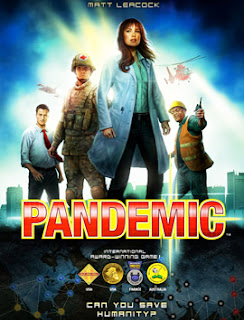
Pandemic for iOS
While zombies had a hand in making apocalypses popular, the Walking Dead didn't do it alone. Depending on how one adjusts the lens, zombie stories punctuate different fears at the micro, median and macro levels.

At the micro level, people worry about their ability to make the right choices. At the median level, they worry about the societal allegories mastered by people like George Romero. And at the macro level, we worry about the real possibility of a pandemic. Just ahead of Halloween, the latter has a new addition.

Two mobile games with a global view of pandemics.

While there are other games on the market, the two smartest pandemic games out are Plague Inc. and Pandemic. Each puts its own spin on the problem, with Plague Inc. inviting you to play as the infection and the board-ported Pandemic offering up a pass-and-play game to cure four diseases.

Both sound more grisly than they actually are, unless you invest in imagining the catastrophic effects of game play. There aren't any overtly disturbing graphics for either high stakes game. Both are played from a global perspective, with the catastrophes playing out on a city or country scale.

A quick recap of what makes Plague Inc. compelling.

Plague Inc.
Plague Inc. has captured plenty of attention since being released a couple of years ago. In fact, earlier this year, the Centers for Disease Control and Prevention (CDC) even invited the founder of Plague Inc. makers Ndemic Creations to speak to the staff. The CDC has become increasingly interested in the game as a tool to teach the public about outbreaks and disease transmission. It even gave Ndemic Creations some tips.

What makes Plague Inc. compelling is its realistic qualities, which game creator and founder James Vaughan attributes to his focus on "infection cycle" mechanics. The infection cycle dictates how people become infected as well as the basic reproduction rate of the pathogen someone is playing.

It's these qualities that help the game remain fresh after hours of play. There are several different kinds of pathogens to change things up: bacteria, virus, fungus, parasite, prion, nano-virus, bio weapon, and the new Neurax Worm and Necroa Virus.

While all of them have similarities, each requires a different balancing act to successfully eliminate humans from the planet. To add even more angst to the mission, game play is a real-time race against the clock. The pace steadily increases as the pathogen moves from being unnoticed to a global threat.

The key to the game is finding the right balance for each pathogen. If the disease is too gruesome, then countries will work harder to cure it. If it is too lethal, it could kill anyone infected before they infect other people. If the threat is noticed too soon, airports will close and borders will be shut down. Iceland never looked better as a place to live as it does in this game.

Pandemic swaps your place in the race for a cure. 

Pandemic
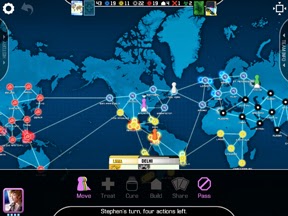
Recently board-ported to tablets, Pandemic is a turn-based strategy game that can be played alone or with up to four pass-and-play participants. While sparing players from any pathogen details, the action commences with the spontaneous eruption of four diseases in different areas of the globe.

The player (or players) must then use four specialists (from a pool of seven) to find cures before it is too late. Cooperation is especially important as each specialist has unique skills that will ideally help the team effort.

Even so, Pandemic isn't easy. The game becomes increasingly challenging as the specialists are overrun by pathogens designed to spread faster than they can be treated. Specifically, there is only one way to win, but there are several ways to lose. Even if you manage to keep the diseases in check, game developer Matt Leacock built in time limits (drawable cards), event limits (outbreak limits) and singular disease maximums (spread limits).

To win, players must globe trot around the world, treating infected populations until they amass enough cards to cure a disease a research center built several turns before. Making matters more challenging, it's common for one specialist to be holding the last piece of an equation but almost impossible to pass on the knowledge.

Plague Inc. Edges Out Pandemic At 8.2 On The Liquid Hip Richter Scale. 

Although players eventually discover that there is one primary objective to almost every scenario, Plague Inc. still creates a level of fun intensity that most strategy games never achieve. It really is a well thought out game.

The newer addition to this genre, Pandemic, is still fresh with a respectable 6.4. It's fun, but in a very different way that sometimes feels less strategic and more left up to chance. A multiplayer option, as opposed to pass-and-play alone, would have given the game another boost.

You can find Pandemic: The Board Game by Z-Man Games (and F2Z Digital Media) and Plague Inc. for the iPad on Apple. Plague Inc. can also be played on an iPhone. The Pandemic board game can be found on Amazon, along with expansions such as Pandemic: In The Lab Expansion Game. Anyone who enjoyed the board game will find it plays much the same way without having to clean up (even if digital can't truly replace the real thing).

Wednesday, June 12, 2013

Warhammer Quest Takes A Game Turn

While Baldur's Gate: Enhanced Edition left some people wondering why anyone would ever create a classic turn-based role playing tabletop game without overcomplicating everything, along comes Warhammer Quest. It delivers Dungeons & Dragons style play better than any app before it.

Although role playing is naturally limited — making the game more akin to a turn-based dungeon crawl (a.k.a. hack-and-slash campaign) — Warhammer Quest does exactly what it sets out to do. It allows you to lead a party of four pre-generated characters on a series of loosely-tied dungeon adventures.

Warhammer Quest works as an interactive story, with you playing every player. 

The party consists of the proverbial troupe made famous by Lord Of The Rings: marauder (fighter), elf (archer), dwarf (fighter), and wizard. There are three additional characters that can be purchased, including classic Warhammer-like characters such as a troll slayer dwarf, warrior priest, and archmage elf. Although the additional character packs are steep, the game is tooled for future character packs too.

The important thing to know here is that while a large party can travel from town to town together, only four find themselves on a quest or adventure at a time. So unless you plan to ignore one of the original four outright, characters will have to be rotated into alternating quests in order to keep them relatively close in level, something that is challenging even if they journey together.

While the characters do place treasure, artifacts, weapons, and armor in a community pool (unless they possess the item), experience is tallied on individual merit with an unfair advantage of last hit being awarded the kill. The point is that every character needs to get their hands dirty to progress.

A quick overview of a turn-based, semi-strategy game. 

The game is mostly broken into three play areas: towns, dungeons and the map. Towns (and cities) are where the party can sell and purchase goods, level up, pray to their patron, and find quests that are tied to a larger overarching story of sorts. Dungeons (and quests) are located around the city, usually consisting of missions (rescues and assassinations), quests (find specific treasure), and arch stories.

The map is how the party navigates between the other two play areas. If they are starting in a town or city, for example, every quest marker within their immediate proximity will be available. Sometimes something might happen on the road, but those stories are mostly scripted content and not real action.


The skirmish elements take place in dungeons and on quests (which are also dungeons with different goals). Much like the board game that Rodeo Games ported into an app, the battle area is a dungeon grid. Characters move to engage monsters, use items or cast spells. Spell casting can be a mixed blessing. Characters within the spell radius can and will be injured by friendly fire. Wild swings can cause damage too. And some characters don't fight well in a crowd, occasionally becoming pinned.

Once you kill all the monsters (orcs, goblins, trolls, etc.), the party collects any loot or artifacts before moving on to the next encounter. It's surprisingly fun, even if turn based means a slower paced game.

What Warhammer Quest currently lacks are any point-and-click search points in the richly rendered landscapes. As far as anyone can tell to date, there are no secret doors or non-combatant encounters.

A little bit about the development team at Rodeo Games. 

The basic game play concept not only comes from Warhammer Quest, but also the perfection of a platform designed for a different franchise. Rodeo Games developed a space story franchise called Hunters and Hunters 2. Hunters 2 has a similar play style as well as some fun customization. The attention to detail is apparent in all their work.

The development team came together specifically to make iOS games in their Guildford, Surrey studio, which is located in the United Kingdom. The developers have worked for a few large-scale projects, ranging from Criterion Games and Lionhead Studios to EA Games and BodyCount.

Warhammer Quest By Rodeo Games Grinds 8.5 On The Liquid Hip Richter Scale. 

Rodeo Games has been known to work diligently at producing additional content for the games it creates, which keeps everything fresh for nominal support. The game already has an expansion pack.

Overall, Rodeo Games has set a new bar. And after talking it over with my editor, there isn't too much that can be improved. A few long-term suggestions might include modest customization for characters (especially names), findable loot (as opposed to automatic awards), secret doors, traps and locks for thieves, etc. And, of course, if they are ever able to port characters or play parties made up of multiple iPad players (especially those entering lightly custom dungeons), they might have a serious run on paper games too.

Warhammer Quest is only available from the iTunes App Store. The initial game is $4.99 and well worth it. While there are in-game purchases and warrior packs, the initial game is immersive, offering plenty of play time. Visit Rodeo Games for more intel.

Wednesday, April 17, 2013

The Silent Age Is A Time Warp Story

The Silent Age
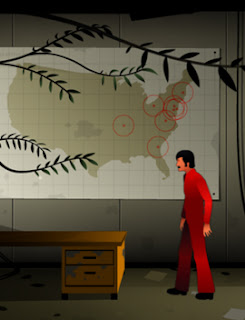
Almost immediately after it came out, we found ourselves sucked into the immersive and mostly flattened world that makes up The Silent Age. Stylish and straightforward, this free episodic story-based game with a time travel twist delivers a surprisingly addictive plot.

The nostalgic element of the game has everything to do with its setting. It's 1972 and change is in the air. This weighs both figuratively and literally on a janitor named Joe, a hypothetical everyman with a mustache who is handed a portable time travel device. It shifts between two times: his present and some well-weathered point in the near future after civilization came to a reasonably abrupt stopped.

Playing in two times gives the game legs. 

Although the puzzle of the game is relatively simple and surprisingly linear, forcing Joe to find and use various tools in a linear cluster (e.g., you can't find a tool in a room that hasn't been unlocked by a key someplace else), the writing and design saves this gem from obscurity. It's creative. And that counts.

There is an unquestionable enjoyment in discovery. For example, a random plant in 1972 grows to block a door in the desolate setting of 2012. The man you passed on a table is reduced to dust and bones, exactly the way he was left for dead a long ago (or in the very near future). So it's all up to Joe to navigate this crazy obstacle course with near average intelligence (or slightly brighter depending on you).


The trick is, of course, to toggle between times and use each to its advantage. A plant, for example, killed four decades ago won't ever grow to wild proportions and block a door. A locked door can't slow anyone down if the walls have collapsed around it. An orange jumpsuit worn by a time traveler remains suspiciously nondescript, mostly to remind Joe (and you) that the fate of humankind has fallen to a chronic underachiever who wasn't even given more clearance until his predecessor met his demise.

The Silent Age falls somewhere between campy and spooky. 

While it might be more fun to have even more interaction in the environment, the game developers seemed to have kept the game play straightforward on purpose. Rarely will anyone become stumped at the successively and lightly progressive challenges that keep getting thrown in Joe's way.

The benefit in keeping it simple is that The Silent Age pace remains largely seamless for the story. Joe never knows exactly what is happening but always has a sense of what needs to happen next. This creates a compulsion to play through with curiosity and will make some people crazy because episode two is not complete.

In order to make the game a labor of love fueled by passion instead of cash, the game developers are asking for donations of $25,000 to complete episode two. Once they do, those who helped out will get the game for free. Everyone else will have the option to buy. Think of it as reverse crowdsourcing as the developers want to reach a no-risk threshold before they give up the goods (which are, at least, party done).

A few words about the indie developers who designed it. 

House On Fire
The game was created by an indie developer based in Copenhagen. It mostly consists of a team of six, with programmer Linda Randazzo, game designer Thomas Ryder, and production manager Uni Dahl (who also programs from time to time). They originally came together to create a different game, Neon Zone, but then became immersed into this alternative universe instead.

Episode two, they say, will also be the final installment. The development team wants to keep the game straightforward without too many extensions. Some players might have feelings about the news, given the expressionless Joe has a significant amount of character. Maybe it's the mustache, originally meant as a Facebook joke for the Movember Moment until fans picked it over a clean shaven hero.

The Silent Age Shakes Up Time At 7.2 On The Liquid Hip Richter Scale. 

If the puzzles weren't so easy and the linear controls not so confining, possibly even alternating outcomes like The Walking Dead, the game would score even higher. But even as it stands, The Silent Age with its stylish throwback graphics and clever storyline is well worth the the investment. It's especially promising as something opens up Pandora's box for more time travel games in the future (or maybe the past).

The Silent Age is currently available from iTunes for iOS devices such as the iPhone and iPad. However, plans are in the works to release the game for the Android too. The company, House On Fire, is very adept at communication through its social media channels. Visit them on Facebook.

Monday, March 4, 2013

Real Racing Revs A Competitive Edge

Real Racing 3
Not everyone was thrilled when Electronic Arts (EA) swooped in to acquire Firemint, a developer that found its Real Racing series frequently outpaced EA's Hot Pursuit series as one of the most loved racers on handhelds. Most people were afraid that the beauty of Real Racing would quickly disappear.

It didn't, mostly. What EA did instead was merge Firemint with Iron Monkey to make Firemonkeys, the new Australia development team responsible for creating the first free-to-play entry in the Real Racing line. Real Racing 3 is an entertaining addition, even with the introduction of new in-game economics, time delay deliveries and repairs, and semi-real friend competition.

Maybe it's best to get the setbacks out of the way.

There have always been two sides to the freemium business model sported by some handheld games. Some people loudly hate it. Some people quietly love it. And the reception that freemium software developers experience is always a crap shoot — wildly successful or painfully short-lived.

Here's the reality of it. On any given day, most of the top ten grossing apps on Google Play and in Apple's Appstore are freemium games. So despite pushback against the concept, too many people are willing to shell out $100 for in-game purchases (or more), even if a paid version valuation of the same game (no in-game purchases) is probably less than $10.

Although many Real Racing fans would prefer a one-time premium game price as opposed to freemium, EA makes a genuine effort to strike the middle ground. It's possible to play EA freemium Real Racing 3 without having to make in-game purchases if you are willing to progress at a less than prideful pace. Not all developers are nearly fair; most make in-game purchases semi-mandatory.

In this case, in-game economics drive the decision. After any given race, drivers will have to use some of their winnings to maintain and improve their vehicles. This includes repairs for damages that occur during the race, routine maintenance like oil changes and new tires, and upgrades to gain an edge.


None of the game economics are unreasonable (especially if players are smart about it), making the free play possible. What might be a little less appreciated is the real-time waiting periods for upgrades and services (incidental repairs are instant). You can spend gold, the game's second and harder-to-come by currency, to eliminate wait times. But if you do, you might be passing up other perks later in the game.

Finally, Real Racing 3 has the promise of real players via Apple's inventive asynchronous multiplayer mode. The time-shifted multiplayer feature allows one friend to race and challenge a second friend one day, and then allow the second friend the chance to race the next day. In other words, racers don't race their friends as much as they race friend "doubles" based on Game Center or Facebook friends who also own the game. It's almost cool, unless you want to race them in real time.

The allure of Real Racing 3 remains mostly the same. 

Although the review invests more room on the setbacks more than the successes, it's largely because the allure of Real Racing hasn't changed much. The beauty of the game has always been associated with its gorgeous design and an intuitive interface.

This time out, EA added additional high performance manufacturers —Audi, Bugatti, Lamborghini, and Porsche — to create a slate of 46 race-worthy cars. As players progress and save some race winnings, they can purchase additional vehicles for their fleet.

Real Racing 3
All of the tracks are modeled after their real-life counterparts — places like Mazda Laguna Seca, Circuit de Spa-Francorchamps, Silverstone, Hockenhemring, Indianapolis, and others. While races can include an immersive 22-car grid, there are several race variations — a combination of styles developed by both development teams. They include drag races, head-to-head races, elimination rounds, fastest times, and fastest speeds.

If you aren't playing with friends, the game will select random players from the Game Center (or Facebook, if you connect the game to your social network) to act as clones. The players selected are generally picked because they are have comparative skills. The only downside is that EA games always gives players the last position in the race (as opposed to affording them qualifying times).

Real Racing 3 Speeds Ahead At 6.7 On The Liquid Hip Richter Scale. 

As far as play tips, always make repairs and take care of maintenance first. It's hard to finish in a paid position with a damaged car. As you accumulate more money, invest in upgrades to boost performance and avoid the temptation to waste gold on wait times.

Eventually, wait times won't matter because you will be able to toggle between cars. Likewise, don't count on upgrades to give you a maximum advantage. You'll have to drop some driver assists, allowing you to barrel through corners faster (among other things).

The bottom line? It's fun and free (unless you choose to fuel it). You can download Real Racing 3 from iTunes. You can also get exclusive deals at Origin powered by EA Games, including other race titles and console game releases. Worst case, you can always delete the game after a few races.

Tuesday, July 31, 2012

Play The Walking Dead In Real Time

There really is a zombie invasion. Independent film, interactive gaming, and literature are all overrun with them. And why not? Zombies are fun. They provide a challenge but are easy enough to beat if you're fast on your feet.

But there is a downside that comes with popularity. Not all zombie offerings are equal. Even people who have a passion for them eventually lose patience if they try to sample everything (much like vampires). I try to be cautious despite being curious, looking for things that pay off like Call Of Duty: Zombies, World War Z, and The Walking Dead. 

It was the tie-in to the series that convinced me to give the latest interactive offering a chance. I'm glad I did. The Walking Dead game for the iPad rocks despite the price point that has some people shaking their heads. 

The Walking Dead from Telltale Games rocks.

Based on the comic book by Robert Kirkman, the Walking Dead game from Telltale is an immersive, choice-based adventure that represents an evolution from its other cinematic story lines. The art is sharper, the interface improved, the pacing more fluid, and the experience feels different.

The choices you make matter. Not all them were inset into the game just to carry the story froward. They change things. If you lie to a character or choose to save one person over another, there are consequences, nuances, and subtle changes forever. Some are more important than others.

Some choices that are more visceral than real make the game surprisingly immersive. But even those that don't change an outcome will change how various characters react to and interact with you later.

The storyline is as rich as the comic or television series. 

The story exists in the same universe as the one many people are familiar with. While this game is based on a different group of survivors, they are geographically close enough to each other to allow for cameo appearances.


The primary perspective is provided by Lee Everett. Everett, a university professor convicted of murder, is being transported out of Atlanta to prison when the epidemic starts. From the backseat of the police car, a few exchanges between the police officer and Everett provide some back story.

It also enables you to set the early tone of the experience. You, as Everett, can be reasonably regretful and cooperative or more callous and disinterested. Depending on how you act will dictate what you learn. And then, bam. 

The police officer is too engaged in chatter to notice the first zombie in the game as it ambles across the highway. The impact causes the car to veer off the road. Everett is left dazed, drifting in and out of consciousness. When he comes to, the world is a very different place. Soon, he meets survivors.

Some are new. Some are old friends. Most notably in Episode 1, Everett meets Hershel Greene and his son before Shawn becomes one of the walking dead. He also runs into the always resourceful and likable Glenn, who is traveling to Atlanta in this timeline. Glenn has yet to meet up with what will become the Rick Grimes group.

The Walking Dead game is more story and less kinetic.

If you are familiar with other games by Telltale, like Back To The Future or Jurassic Park, you'll have some sense of the Quick Time event (QTE) environment. The Walking Dead is better, and delivers what seems to be the right amount of length for each episode. Expect about two hours of playtime each.

The story itself is strong enough for anyone feeling starved for the series between season breaks. It has stood on its own as a digital comic. Anyone who plays, however, will be glad there is more. The sense of controlling some character's destiny is entertaining, even if it is limited.

There are a smattering of forgivable setbacks. For instance, if you see a dead police officer, you really want the ability to search for his side arm. You can't unless it's in the script. Weapons and useful items are relatively constricted.

The next most common critique is how the game is being released. Across all platforms, players are anxiously awaiting installments. Episode 2 was just recently released (but not for the iPhone or iPad). Episode 3 might arrive by mid-August.

More troublesome for many iPad and iPhone owners is pricing. The Walking Dead doesn't distinguish between platforms, charging $4.99 for Episode 1 and $14.99 for the bundled preorder, Episodes 2-5. I don't personally have a problem with it given this isn't a stripped down game, but iOS customers are becoming increasingly frustrated by price creep. This one nearly eliminates portable platform savings.

The Walking Dead Game By Telltale Survives 7.2 On The Liquid Hip Richter Scale. 

The most fascinating aspect of the Walking Dead is it is among early entrants in the evolving cinematic game concept. This kind of gaming — balancing an interactive comic, light action, easy puzzles, and psychological depth — seems like this would be a natural fit for the future. It could be especially be great for games based around James Bond or Star Trek.

For portable iOS, The Walking Dead is only compatible with iPad 2 and up or iPhone 3 and up from iTunes. It is also available for the PS3, Xbox 360, and PC/MAC platforms. The Walking Dead [Online Game Codes] can be found on Amazon. My review is based exclusively on the iPhone and iPad experience where it feels natural despite being the last platform.

Wednesday, May 30, 2012

Autumn Dynasty Inks Beautiful Battles

There have been relatively few true real-time strategy (RTS) games developed for the iPad, but expect that to change soon. Autumn Dynasty is as playable as it is beautiful, setting a higher bar in the process.

Although the campaign play is woven together with a simple but intelligent storyline, the crux of the game by Touch Dimensions is a large scale real-time military combat simulator set in medieval Asia. Players command units of swordsmen, pikemen, archers, horsemen, calvary, and catapults while building an infrastructure (forts, camps, outposts, towers, and farms) to expand their growing military.

Anybody who has ever played any real-time strategy game ought to know the drill. Players want to build as much as possible, which aids in training a larger army. At the same time, it's likely they will have to defend their encampments against an increasing onslaught of enemy units.

There are four ways to play the game: campaign, skirmish, bluetooth (iPad vs. iPad), and online. No matter which game play you pick, there is considerable attention to detail. It ranges from the storyline of a campaign to the single-player skirmishes that allow for one of three different artificial intelligence (AI) opponents.

The artistic stylings of Autumn Dynasty makes it a standout game.

Most real-time strategy games have to balance speed and art. Autumn Dynasty doesn't have to. By choosing a visually appealing minimalistic design, the game looks great without sacrificing speed.

It plays out on a landscape that carries the simple but striking look of a Chinese ink wash painting, a timeless technique dating back to 600 A.D. The environment looks like it was inked and painted on parchment. The various units are simple while showing off some tiny, well-designed brushstrokes.

The best part of the art is that it goes beyond merely mimicking the look of an ink wash painting. The entire goal of ink wash painting is to capture the soul of whatever is being reproduced. And as units are directed with the graceful lines of touchscreen orders, they do seem to come to life on the screen.


The design and movements of the units and look of the buildings also make it even easier to forget that the game itself is based largely on rock-paper-scissors behind-the-scenes game play. It feels like playing a piece of history. Of course, there are other variables thrown into the mix.

Called doctrines, Autumn Dynasty adds variables that include special training for each unit: improved equipment, building enhancements, special skills, and elemental magic. Each doctrine has numerous abilities and three tiers in each to provide units and buildings with more and more power.

Making minute-to-minute decisions on whether to build, research, or train more units (and what kinds) is especially challenging in the single-player skirmishes. Most players will want to start with the campaign mode because it is as much a general a tutorial as it is game play with a decent back story.

A small introduction to the campaign story of Autumn Dynasty. 

The storyline is straightforward but interesting enough to hold attention, even when it is drawn out during a few of the cut scene sections. (It can always be skipped too.)

The nutshell version is that peace in the ancient Empire is threatened by a growing divide between the North and South. Rumors of unrest have prompted the bureaucracy (made up of farmers, nobles, and soldiers) that runs the Empire to commission an investigation.

Then again, a looming civil war seems certain as the South has not paid its annual taxes. But nobody told Scholar Hsu, because he sets out to investigate on behalf of the North with nothing much more than a wagon.

You know what happens next. Like any RTS that begins this way, some campaign scenarios are meant to be lost to advance the story. In this case, being robbed helps Scholar Hsu meet General Li.

Mostly, protagonist Scholar Hsu (the player) is looked upon more and more like a leader (assuming the payer does well). Told primarily in a cut scene storyboard fashion, each captioned frame carries the theme of the ink brush art renderings forward, creating a very promising game experience. What isn't as straightforward is that it becomes increasingly obvious the developers built in a plot twist or two.

Autumn Dynasty For The iPad Renders 9.1 On The Liquid Hip Richter Scale. 

Touch Dimensions has created a painstakingly detailed and very playable game with enough variations to keep the story from becoming too tedious. The ink brush painting concept is perfect, not only because it fits in with the medieval Orient, but also because it provides just the right amount of detail. It's also obvious that the game was specifically designed for tablet play; mastering a few gestures is simple.

Touch Dimensions said its distributor, BulkyPix, will offer Autumn Dynasty at an introductory rate. Some people shy away from games priced at $5 or more, but this one is worth it if you like RTS games. The game was originally conceived in 2009, but dramatically improved with better unit graphics and the removal of the paint brush pointer.

Wednesday, March 7, 2012

ArtRage Is A Catalyst For Creativity

When you think back to the prelaunch of the iPad, there seemed to be an abundance of skeptics. Many likened the iPad to an oversized iPhone, which had also endured its share of skeptics just a few years earlier — people who tended to see the world based on what they knew instead of what they didn't know.

Steve Jobs was different. He relied primarily on his own instincts rather than focus groups and market research. He did it because people tend to struggle when trying to completely imagine something that doesn't exist. All that changes when they hold what they thought to be impossible in their hands.

Sometimes I wonder if even Jobs knew what he had in the development of the tablet. But then again, maybe he didn't have to. He knew once it was on the market, other people might use his impossible to create their improbable, especially in arenas like music and art.

A quick overview of three drawing and painting apps. 

Most artists and designers have already found their favorite apps as they rolled out over the last few years. There are many worth mentioning, and some deserve independent reviews. I'll mention three.

Like many art apps, SketchBook Pro was designed especially for tablets and digitized pen tablets. As an app, it's hard to beat as one of the fastest and most reactive drawing tools available. It's amazingly useful for fast concept work, especially if you want to include preset hard shapes (lines, squares, circles), auto-smooth draw, and color fills. The mirror tool, free transform, and eraser are standouts. 


The art tools in the arsenal include pencils, pens, markers, and airbrushes. The program is surprisingly intuitive, helping to eliminate the learning curve and quickly enhance the casual pen-and-paper artist's work. It's truly impressive and will no doubt take full advantage of the next generation iPad HD. 

Brushes was one of the first art applications designed for the iPhone and then the iPad. As the first, it had the advantage of becoming a favorite among many artists who really grasped the potential of digital art. Some of the best functions include its color picker, eye dropper, and ability to create some interesting textures with a variety of brush patterns that always reminded me of Aldus Superpaint. 


Brushes can be fun and plenty of people have created some amazing work. But there are two downsides. As good as Brushes is, it almost forces a style on the artist, enough so that the finished work often looks like it was created in Brushes. It also has the steepest learning curve of the three mentioned, making beginners feel like they have to learn the program as much as art technique.

While both serve their purpose (SketchBook Pro more than Brushes), ArtRage has an edge as the most complete, versatile, and intuitive art app for the iPad. Unlike Brushes, ArtRage wasn't originally designed for the iPad but was brought into it. What truly stands out is that the app feels like an art simulator more than it feels like an art application.


It's fair to say ArtRage lives up to its promise for traditional artists — it feels familiar in every medium. And by every medium, ArtRage delivers the most: oil brushes, watercolor brushes, airbrushes, pallet knives, rollers, paint tubes, pencils, ink pens, felt pens, crayons, chalks, pastels, and paint buckets. 

All of them do a surprisingly good job simulating real life tools, with scores of options. There are varied degrees of sizes, pressures, softness, and wetness for each art tool. There are 24 preset canvases,  which can be adjusted for metallic, roughness, gain, and color.

ArtRage has an edge because its functionality expands with the artist. 

Along with these features, presets, and properties, ArtRage allows artists to work naturally, with or without the benefit of layers (with adjustable transparency). They can paint over or blend colors (using the pallet knife or a wet brush) like a real canvas or use the graphic design layers to sketch an image with a pen or pencil on one, and then paint the sketch on another, without picking up sketch marks. The bottom layer can be deleted upon completion.

While nowhere near as polished as the practiced hand of Caesar or other artists, the untitled figure (right) was my first trial with ArtRage using a stylus, allotting 15 minutes from concept to creation. I hadn't really drawn anything in ten years (beyond fingerpainting with apps). It was surprising how natural it felt, even if it wasn't perfect.

In addition to design, ArtRage also provides more flexibility in transferring the image. While SketchBook allows images to be saved to the photo library or Cloud (a recent upgrade), ArtRage allows work to be sent as a JPG, PNG, or PTG to photos, email, online storage sites, or even iTunes. As a digital file, it's easy enough to embellish it in PhotoShop or Illustrator.

ArtRage By Ambient Design Draws In At 9.5 On The Liquid Hip Richter Scale. 

While any of these applications will work with nothing but fingers, a stylus is welcome for anyone who feels more conformable drawing or painting with a tool. While I am currently waiting for two new experimental styluses (one that simulates an actual paintbrush and another that brings a fine point to the digital screen), the Targus stylus is still the best on the market. It doesn't take much to forget you aren't using a pen and paper or paint and canvas. 

All three applications for the iPad are available on the iTunes App Store. ArtRage by Ambient Design is $6.99,with periodic discounts. Brushes by Taptrix is $7.99. SketchBook Pro by Autodesk, Inc. for the iPad is $4.99. If you are still not sure about how convincing the art can be, SketchBook Express, which is like Pro with some limitation, is available for free. All three apps also have iPhone counterparts (two with desktop versions), but the bigger screen makes all the difference.

Tuesday, January 31, 2012

Color Uncovered Is Wildly Insightful

Although the release of iBooks 2 textbooks (selling 350,000 textbooks in three days) stole some thunder from recently released educational applications, it's impossible to ignore Color Uncovered from the Exploratorium in San Francisco. Its recently released educational app is wild, beautiful, and free.

The subject is color. And while designed with children in mind, the program can easily be considered a must have for artists and photographers — especially those who haven't studied color, light, and pigments. Color Uncovered presents just under 20 exhibits similar to those that you might see at Exploratorium stations except they are beautifully recast for the iPhone, iPod Touch, and iPad.

The hero shot is the first exhibit, featuring an optical illusion that helps demonstrates how the brain fills in shapes that it expects to see rather than what is actually there. The faint blue square you see, for example, is absolute fiction.

The interactive experiments capture attention, but how you apply it counts.

Most reviews have touted it as an educational tool, mostly for children. The assessment comes from the interactive feature included on the page. Each of the circles can be pulled outward, disrupting the pattern. It's fun, even if it could be more than that.

Depending on how you apply the lesson, different ideas emerge. Someone who is science minded might consider the theory that the optical illusion is a latent ability that once helped us see faint outlines underwater.

The artist, designer, or photographer might take away something else. Paintings or photographs could impart entirely different meanings by taking in what our brains are all too ready to see. While not necessarily new on its own, there are more mini exhibitions to explore, including a better understanding of Claude Monet.

The French impressionist had more than light in his eyes.

While many people are familiar with the the French impressionist's paintings, especially Water Lilies, there is more to the story than being included in exhibitions for breaking with tradition. According to Color Uncovered, Monet could see and frequently painted patterns and colors to include the ultraviolet spectrum.

He acquired the ability late in his career after he developed cataracts that dulled his vision. In 1923, he underwent surgery to have them removed. The unexpected result was allowing him to see the ultraviolet spectrum, which a normal lens is equipped to filter out. In other words, water lilies look white for most people but Monet saw them how he painted them — pale blue with vibrant patterns.

A cross sampling of color exhibits within Color Uncovered.

The application presents dozens of optical illusions, most of which are interactive or ask for specific participation to make the optical illusions work. Don't be surprised to recognize a few if you've sought out optical illusions before. Where Color Uncovered shines is in the explanation.

Your eyes will make spots disappear, imagine colors that don't exist within the pigments used, demonstrate how the mind is attracted to luminance, or how color saturation can seem fleeting. One of the most striking (even if you've seen it before) is how the brain can colorize a photo based on nothing more than color negatives. The effect only lasts a second, but the artist's application is mind bending.

Of course, not all of the screen exhibits are about how we see things. Sometimes they are about how things are. As most designers know, computer screens only use three colors. As most photographers know, incandescent lights add more reds and halogen lamps emit more blues. Or as only people in the tropic might know, oranges are really green unless they've been treated with ethylene gas or blasted by cold.

All in all, the app is light on content in that it can be digested in the quick span of half an hour, maybe an hour if you are really concentrating on each experiment (and watch all of the videos included in the Shades of Meaning, which is the least grabbing of every thread).

However, just because the app is 17 exhibits today, that doesn't mean it will have 17 exhibits tomorrow. The Exploratorium originally launched the app with 11 pages. The additional exhibits were added as an update.

Color Uncovered By The Exploratorium Surprises At 5.4 On The Liquid Hip Richter Scale. 

As a free education application, the Exploratorium has put together a great starting set for anyone interested in light, color, science, and perception. The physical Exploratorium is a museum of science, art, and human perception with hundreds of explore-for-yourself exhibits. The museum will be moving to the San Francisco's historic waterfront in 2013.

You can find Color Uncovered for free on iTunes. You can also learn more about the Exploratorium  on its website. For those interested in the work of Claude Monet, we found a surprising collection of prints, museum prints, and canvas prints at Barewalls (including Water Lilies). Just search for his name.

Monday, October 31, 2011

Sky Gamblers Flies For Dogfights

There have been about 70 World War I flight sims on the market at one time or another since Atari released the Red Baron in 1981. Game play has always been all over the map, which is why most of them enjoyed a quick pickup of interest before falling off the radar, usually to more modern aircraft.

But there is one World War I flight sim that could have a longer shelf life. Rise Of Glory: Sky Gamblers invested development in the flight controls to create a realistic flight experience with better maneuverability than any combat flight simulator for the iPad, iPod, or iPhone.

Sky Gamblers wins with a richer, more complex control system.

There are some people who are complaining about the controls, but it is the controls that make for such rewarding game play. Pilots can control the planes with a combination of tilt (three-axis gyro), rudder (on-screen touch), throttle (on-screen touch), and finger motions (special maneuvers).

The primary complaints are related to using the three-axis gyro (tilt) component. Ignore them. The learning curve is quick, and the dual movement controls (three-axis tilt combined with touch variations) are what add a dynamic to aero-stunt flying in combat. If you can master those combinations, finger motions for special maneuvers aren't even needed. The responsiveness is that good.

Sky Gamblers offers up a diversity of vintage flying experiences.

The planes are modeled off of eight different designs (with two versions each). Two of them are based on the most famous from history: Sopwith Camel, which was piloted by Major William Barker; and the Fokker Dr. I, which was the mount of the Red Baron Manfred von Richthofen. With the possible exception of the Sopwith Triplane or Spad XIII, players gravitate to the more famous planes.

The most common exception is the Spad. Without question, the Spad was the most capable fighter toward the latter part of World War I. But much like real lift, there are tradeoffs in the game. The Spad is significantly faster, but feels less maneuverable than the Sopwith Camel or Fokker.

Maneuverability is important, especially while playing against real opponents. At faster speeds, you lose too much of it. (That's not a game fault, it's a flight truism.)

Other planes in the game include the Bleriot, BE2, RE8, PFALZ, and Albatros. All are unlocked by playing the campaign, which is especially important before taking the game online.

Some people don't seem to know this, because it's not uncommon to see players attempting to fly a Bleriot against pilots with the Sopwiths, Fokkers, or Spads. They don't have a chance.

Campaigns, dogfights, customs, and online options. 

The campaign is the best place to start for another reason, with the player piloting a Bleriot with tutorial instructions to understand the basics of the game and get a feel for the flight. Some missions are harder than others (and it took me awhile to understand the 'photo' mission), but playing the campaigns is the best way to understand the flight controls.

Each mission focuses on different elements, ranging from strafing or bombing ground units to dogfights and taking out balloons. While many people like to bypass campaigns and head to online game play, it's very much a mistake in Sky Gamblers.


Likewise, dogfight missions are progressively more challenging in head-to-head fights against aggressive artificial intelligence pilots. The level of difficultly increases with game play against various mixes and matches between the number of enemies and wing men. I've personally found that it's always a good idea to play at least one dogfight mission before joining the online games.

Custom games are also worthwhile for the same reason. It's the best chance to learn some of the online scenarios — free for all, team deathmatch, defend the base, and capture the flag — before playing online. But eventually, online is where you will want to play. Nothing beats the online challenges with up to eight players per game (or on a local WiFi).

When you do play online, expect most gamers to play free for all or capture the flag. This may change as more people pick up the game (almost all games develop loose friendships, alliances, and clans after awhile).

Anyone playing will also find that human opponents are easier than the artificial intelligence for now. As players pick up more tricks (such as not flying away from opponents and using the throttle to enhance maneuverability), it will be very likely to change.

The game does have a ranking system based on kills versus deaths, with kills earning two points and deaths equally one point. The system is fair instead of harsh, giving everyone the opportunity to move up quickly (unless they fly a Bleriot, which is like a knife in a gunfight).

Sky Glamblers was developed by a division of Namco Bandai. 

Sky Gamblers was the creation of Namco North America, Inc. It has dozens of titles, but is possibly best known for the cinematic Ace Combat, which is becoming even more video-realistic this year. It's safe to assume its experience with flight sims and the iPad, iPod, and iPhone platform paid off.

Even better, Namco Bandai seems to have learned its lesson about in-game purchases. Last year, the company launched Ace Combat for the iPhone and iPad, but players complained. I'm glad they did. Requiring people to make in-game purchases has made flight games like Skies of Glory (World War II themed) and F.A.S.T. (modern aircraft), both by SGN, largely unplayable.

Sky Gamblers: Rise Of Glory Takes Flight At 8.3 On The Liquid Hip Richter Scale. 

Namco Bandai has developed a near-perfect flight game with Sky Gamblers. Hands down, it is the best historic flight combat app available. The only way to make it better is to continue to build out the campaign scenarios and add more features to customize the planes.

Rise Of Glory: Sky Gamblers is available for download in the iTunes App Store. If you are interested in World War I, consider renting (don't buy) The Red Baron, which is short on story but fun for the aerial flying. The better movie is easily The Blue Max. You can also find The Red Fighter Pilot: The Autobiography of the Red Baron by Manfred von Richthofen on Amazon. There is much less is written about Major William Barker, to whom history has been less kind, despite his numerous accomplishments and receipt of the Victoria Cross.

Monday, September 19, 2011

Set Course For Crimson Steam Pirates

Hands down, Crimson Steam Pirates is the most meticulously polished adventure strategy game created to date for the iPad. It's set in a richly detailed environment similar to the high-flying steampunk world of Crimson Skies, except the hero or heroine sets sail with a top-down fleet rather than climbing into the cockpit.

Crimson Steam Pirates revolves around the character of Thomas Blood, who is based in part on the real Thomas Blood, an Irish colonel best known for attempting to steal the Crown Jewels of England. Except this Thomas Blood exists in a world made entirely of imagination, an alternate universe that extends the reign of the steam engine and futuristic Victorian-era Brits battling it out in the West Indies.

The sea isn't the only place to command the fleet. Blood is also given the occasional submarine and zeppelin, creating the illusion of three planes of adventure instead of just one. Occasionally, even the icons of the era make guest appearances — Mark Twain and Nikola Tesla among them. 

The steampunk storyline of Crimson Steam Pirates. 

While Crimson Skies takes place in 1937, Crimson Steam Pirates begins in 1888 with Blood captured in the Canary Islands and loaded aboard the Albatross, a steam-powered transport ship. In this alternate reality, many similarities ring true. 

Queen Victoria still rules, America's Civil War borderlines have become borders, and steam pirates now thrive alongside British, French, American, and Confederate forces. And, it is the steam pirates who board the Albatross before Blood is ever exiled to an English labor colony in Jamaica.

Based on nothing more than his reputation, the beautiful steam pirate Captain Blackheart frees Blood and agrees to make a stake in him as a partner. To help with his start, Blood and Blackheart's first mate, Cordelia, are given the newly captured Albatross and a tip to free their first crew member from a British prison.


Captaining the Albatross is not enough to make the game worthwhile. With each adventure, Captain Blood is given additional ships at his disposal, including lighter-than-air blimps and Nautilus-styled  submersibles. Each adventure also carries a plot and subplots that are difficult to follow the first time through, but only because the game makes you want to race ahead and play. 

Crimson Steam Pirates adds strategy with turn-based animated play. 

The game is turn based, but it doesn't always feel turn based. After giving each ship instructions, they follow the course laid out for them with the crew automatically firing on enemy ships, forts, and ports.

On the surface, it seems simple for a strategy game. But along with plotting the ships' courses, captains have to weigh various options, including which special ability is the most worthwhile to order up (assuming the right characters are on board): full steam power, ship repairs, grappling hooks, etc.

How many turns it takes to complete a mission matters. In addition to earning points for every enemy ship destroyed and objective met, captains receive bonus points for completing each voyage under "par," the number of turns required to complete a voyage.

Alongside game play, the ability to sink deeper into the details is one of the most fascinating aspects of the game. Click on any ship and its armament and engines (as well as their condition) are in plain sight. Click on crew detail and every meaningful character on board is outlined, complete with mini-histories and special abilities that become increasingly important as the game progresses and when characters attempt to board ships.

A quick bit about Harebrained Schemes and Bungie Aerospace. 

Harebrained Schemes is a small group of creative types working wildly under the direction of serial entrepreneur Jordan Weisman. Not only is Harebrained Schemes working to expand the amusing and snarky Crimson Steam Pirates universe, but  has several other projects in the works, including the Trans-media literary experience, funded in part by Educurious and the Bill & Melinda Gates Foundation.

Harebrained Schemes' Crimson Steam Pirates is being propelled by Bungie Aerospace, a company that not only creates games but also helps independent developers launch their games like a publisher. They help find financial backing, introduce audiences, and offer technical expertise (like stat tracking) and advice. Creativity abounds there.

Crimson Steam Pirates Boards At 7.8 On The Liquid Hip Richter Scale.

There are several areas where Steam Pirates could be improved, but the immersive universe isn't one of them. It would be nice to see a better boarding module, something similar to the game play besides an updated version of the card game war. But for now, it's not too distracting. Second, while you can skip the storyline and play head to head against a friend, the duel option is limited to pass and play.

No worries. All good things in time. You can find Crimson Steam Pirates on iTunes. The iPad game, including its first saga chapter (eight voyages) was free when we downloaded it. The second chapter can be purchased as an in-game add-on. If you like the game at all, you'll want to purchase it straightaway. It's smartly steampunk.

Monday, August 8, 2011

Targus Stylus Tops The Fine Arts List

When the iPhone and iPad were first released, plenty of people questioned their lack of a stylus. I think Apple was smart to launch without one because the capacitive touch screen (electrons current in our fingers) could do so much more than a pressure sensitive touch screen.

However, as iPhone and iPad apps have evolved to become increasingly intuitive, especially for artists, a stylus makes sense. It may even be a necessity — one that is increasingly apparent with apps like Brushes and ArtRage.

Fingers are great for finger painting, but drawing, painting, and note taking call for a tool to make everything feel more natural. The answer has come from third-party innovators, especially Pogo and Targus. I expect new names ahead too.

A quick comparison between two stylus brands.

Pogo was one of the first to garner attention last year, and is still a contender by most measures. The work produced with a stylus has been pretty amazing. The general concept started when Pogo developed a material that tricks the iPad into believing that the soft felt-like foam tip is really a finger.

Even so, that doesn't make it the best stylus on the market. While some people have said it's not responsive, my take on it is a bit different. It's not the pen-to-pad resistance that throws people off. It's the resistance between the tool and our tactile sense.


That doesn't mean Pogo is the best or worst stylus on the market. But it does open the doors for others. So to create more resistance between the tool and our hand, another manufacturer created a firmer foam that almost feels like a soft rubber. That makes it easier to create thiner lines with a softer touch, and helps reduce drawing or writing fatigue.

The Targus seems to be the preferred stylus brand today. But you might be interested to know it came out shortly after the Griffin. I've found that the two —Targus and Griffin — are virtually the same. Originally, Targus came out for about $5 less. But I've noticed that Griffin has since reduced its price.


Not everything about the Targus is perfect. It simply performs better than any other I've tried over the last six months. As an instrument, the simple metal body and matte black finish (no branding) feels more like the writing and drawing instruments we're all used to. The only criticism is that the length feels short. It would be nicer to have a longer instrument.

According to some other stylus reviews I've read, iFaraday has come out with a longer stylus that artists who appreciate a lighter hand seem to appreciate. I haven't tried the iFaraday yet, so I can't say. The real interesting innovation here is that they have created more tip and barrel variations. Good idea.

A brief bit about dual-use stylus tools and expectations.

Since the stylus has moved closer to being a perfected tool, several manufacturers have added pens or pointer lights to the back end. While there is nothing wrong with that, none of these add ons make the stylus feel more comfortable. The pointer versions are especially disappointing because they add considerable weight to the tool. My advice is to stay away.

Targus ArtDon't expect any stylus to be a permanent purchase. Some people say the tip starts to show wear after about six months. While some shops are marketing replacement tips for various stylus brands, I'm not sure it makes sense. For less than $20, it might be better to buy a new pen.

In addition to the manufactured pens, several people have come up with other solutions too. I really appreciated one video in particular that shows people how to make their own, which could mean much more diversity in tool length and tip size. Even more creative are people who have tried a carrot. It works (so do grapes), but expect to clean your iPad more often.

The Targus Stylus Tops Fine Arts At 6.9 On Liquid Hip Richter Scale.

Fingers are still best when it comes to functionality, but the right stylus wins out for fine arts on an iPad. It creates the bridge between graphic arts and fine arts that many artists have been craving since art made the move to a digital format. It feels much more natural than a digital pen, but I anticipate that all of these tools are due for another evolution this year.

You can find the Targus stylus almost anywhere. We found the Targus stylus is listed for about $11. If you want to try the Pogo Stylus instead, Ten One Design has dropped its price to around $6 on Amazon. And I have to give some extra credit to Ten One Design. Their annual art contest has brought out the best in what can be done, including that famed Brushes illustration from 2009 by Goro.

Monday, April 18, 2011

Need For Speed Hot Pursuit Has An Edge As A Racer

Hot PursuitLast November, when Electronic Arts (EA) came out with its Need For Speed Hot Pursuit (Hot Pursuit), it added a dimension to racer games that is hard to beat. Hot Pursuit did exactly what it promised to do. It redefined open road racing with its stunning graphics and a variety of choices for game play.

The ability to play as a racer or play as the police creates an added challenge that many racers don't have — someone is out to not only beat you, but someone is out to wreck you in a game that falls somewhere between Mad Max (minus the post-apocalyptic world) and the underworld subculture of street racers from the Fast and The Furious.

Real car modeling and dynamic landscapes bring it all together.

The beauty of the game relies in part on the immersive landscape and real car modeling. EA Games gives a nod to Porsche, Alfa Romeo, Aston Martin, Bugatti, Koeningsegg, and McLaren to name a few. Many of them are featured as racers and cops, with the fictitious Seacrest County PD having only a few less options.

Seacrest County is loosely based on Southern California's diverse landscape, with deserts, coastal roads, forests, and mountains. Each of the landscapes creates some rich environments with trafficked roads for high-speed chases during the day, dusk, or night, no matter what console, computer, tablet, or phone you play the game on.


Depending on whether you play as a racer or an officer, you will have a variety of objectives. Officers are primarily charged with shutting down racers using whatever means necessary, including ElectroMagnetic Pulse, road blocks, and (my favorite) spikes. However, there are other challenges, including timed response times and competition with other police.

Racers play the opposite objective. They either play to win, play to avoid police, or break as many speed laws as possible. Unlike playing the police (who primarily keep their eyes in front of them unless playing live opponents), racers have the dual challenge of avoiding traffic and natural obstacles while police cars follow tightly behind and attempt to run you off the road.

Game play adds portability to the experience with the iPhone and iPad.

I was originally introduce to the game because EA Games recently added Need For Speed Hot Pursuit LITE for the iPad in April. It's also available for the iPhone.

The free download gives you an opportunity to play one round as a racer and one round as an officer. One round is about all it takes to addict anyone who enjoys high speed gaming to purchase the full higher priced games ($4.99 for the iPhone; $9.99 for iPad). However, before you do make the purchase, you need to know that neither are full versions of the game.


While the landscape conversions are impressive, the vehicles do sacrifice considerable graphic quality (making it feel like a Wii adaption, although still slightly better). The game play is also stripped down, with a little less happening on the highway. This is somewhat disappointing given Firemint's Real Racing 2 HD proves you don't have to drop graphic quality. In fact, Firemint was the first to demonstrate the game play power of the iPad 2. It ports video at 1080p, making the tablet feel like a console game. (It also plays on the iPad and iPhone too.)

Even if there are more dynamics to Hot Pursuit, Real Racing 2 proves it is a plausible possibility. Still, while Real Racing 2 has the graphic edge and one of the most fluid racing experiences ever, there is something more of an adrenaline rush of a high speed pursuit that gives the EA game an edge even on the iPad.

Need For Speed Hot Pursuit Roars To An 8.9 On The Liquid Hip Richter Scale.

For the iPhone or iPad, Need For Speed Hot Pursuit might drop to 4.2, which is still solid on the scale. However, even with some of the sacrifices that EA Games made to make the game portable, it still provides all of the excitement you'll find on a console or PC.

The Need For Speed Hot Pursuit (Xbox 360) is available from EA Games. You can also find it for the PC, Wii, and Playstation 3. For Apple fans like me, head over to iTunes for The Need For Speed Hot Pursuit for iPad or The Need For Speed Hot Pursuit for iPhone. You can also pick up Real Racing 2 while you are there. Or, if you're still hesitant about the price of either game, try Uber Racer 3D Sandstorm for 99 cents.