Showing posts with label Knopf. Show all posts

Friday, August 29, 2014

Nick Harkaway Claws Out A Tigerman

Tigerman
"If Pippa Middleton and Megan Fox had announced their intention to marry during a live theatrical production of Fifty Shades of Grey starring Benedict Cumberbatch, and then taken off their clothes to reveal their bodies tattooed with the text of the eighth Harry Potter novel, they might just have approached this level of frenzy. But probably not, the boy said, because not everyone liked Benedict Cumberbatch." — Tigerman by Nick Harkaway.

Frenzy is precisely the right word to describe the atmosphere on the rapacious backwater island of Mancreu. On any other day, it might not be. But these days are different. The former British colony is sitting on a volcano poised to belch a mysterious and toxic elixir of chemicals into the atmosphere.

The international community, concerned for its own safety, is determined to do something. Their solution, expectantly enough, is to blow the entire island up. And while this idea might not work, everyone will feel satisfied that they at least did something.

It's the end of the world for Mancreu. And everyone feels fine. 

Except, not everyone. Sergeant Lester Ferris, who is acting British Brevet-Consul by default, has befriended a brilliant street kid with a comic-book fixation. He appropriately calls himself Robin.

Like many of the citizens of Mancreu, his fate is uncertain. Once the international community evacuates the island, the boy will need a new home. And the war-weary 39-year-old veteran of Iraq and Afghanistan sees himself as a candidate to become the boy's father — assuming he is an orphan.

Tigerman
Robin may need some additional help too. As the island's fragile society begins to break down in the face of a manmade doomsday, the multinational array of shady businesses that have parked themselves offshore are growing restless. Called the Black Fleet, this illicit collection of ships includes spy stations, arms dealers, offshore hospitals, money-laundering operations, drug factories, torture centers, and other nasty elements.

The societal breakdown and offshore urgency eventually collide when a gang bursts into a citizen's bar and shoots it up, killing Robin's friend Sholax. It is this event that kindles Robin's idea that what the island really needs is a superhero — one that he believes can be assumed by Sergeant Ferris.

While never intending to do much more than appease the boy he is beginning to love like a son, Ferris agrees to assume the identity of a superhero conjured up from the boy's imagination. At minimum, Ferris believes he can investigate the murder as Tigerman while following orders to do as little as possible and watch over the former consulate house. This passive plan fails outright and Tigerman not only captures the heart of Mancreu, but also the attention of the entire world.

A few graphs about author Nick Harkaway. 

Nick Harkaway
Nick Harkaway burst onto the literary scene when his first novel, The Gone-Away World, found itself in a seven-way auction between publishers. It was eventually won by Heinemann, which paid a £300,000 advance for the story about special operatives who are hired to perform a mission in an post-apoclypic world. He followed this novel up with Angelmaker.

He was originally born Nicholas Cornwell and educated at the University College School in Norht London. He studied hilosophy, sociology and politics and took up Shorinji Kan Jiu Jitsu. He doesn't talk about such as much, preferring to share more important information like enjoying Italian red wine, unlikely clothes, Chinese food, good-humoured anecdotes, Argentine tango, Swiss cheese, American burgers, carving skis, alpine snowboards, P G Wodehouse, Alexandre Dumas, and blonde human rights lawyers (especially the one he married). They have two children. He is full of win.

Tigerman By Nick Harkaway Punches 9.2 On The Liquid Hip Richter Scale. 

Tigerman has an authenticity that slowly sneaks up on its readers as Nick Harkaway tackles parenthood, friendship, and loyalty under the guise of secret identities, heroes, and what it really takes to be one. Although contemporary, the tone has an expressly human and vintage quality to it. It is one of those rare books that someone reads and feels like a better person for having read it.

Tigerman: A Novel by Nick Harkaway is available from Amazon or can be downloaded for iBooks. The audiobook is also available from iTunes, narrated by Matt Bates who brings the story to life by balancing the protagonist's pragmatism and boy's enthusiasm. You can also order Tigerman by Nick Harkaway from Barnes & Noble.

Friday, June 13, 2014

Peter Heller Bristles With The Painter

The Painter by Peter Heller
When celebrated artist Jim Stregner abandons his home in Santa Fe for a fresh start in the valleys of Colorado, he pins his hopes to the notion that his love for painting and fishing will be enough to conquer alcoholism, a gambling addiction, and a predilection for violence. For the most part, they will.

With the support of 28-year-old Sofia, who agrees to model for his latest work — An Ocean Of Women — he believes he might have a chance. He came to Colorado only four months ago, another chance to put a past he could never escape behind him.

His marriage fell apart after the loss of their daughter. He will never get over it. He blames himself for not being able to protect her despite serving prison time for beating a man who once leered at her. In fairness, the man did more than that. He practically taunted Stregner into action.

Jim Strengner is a reluctant and remorseful hero. 

When he keeps to himself, Stregner is genuinely likable. He has a sense of humor, even if it leans dry. Affable might even be the right word when he isn't counting his losses. He paints, fishes, and makes every effort to move on with a life he never wanted. Most would say he is wildly successful at it.

On the surface, he is exactly what most people want him to be. He is a reclusive and somewhat renegade artist who paints well outside the mainstream. His work is striking in character because he is unafraid to paint what he feels — dark and haunting works with layers of meaning.

Fly Fishing Colorado
His life might have continued on that way had it not been for a random roadside encounter with Del Siminoe. But when Stregner sees Siminoe whipping a horse into submission, he can't help himself. Stregner steps forward to stop it and the blind rage he keeps otherwise bottled up escapes.

The Painter is a profile of a gentle, introspective soul with a dark side that can only be drawn out through provocation. He doesn't mean to do it, but he kills Siminoe on the road and attempts to cover up the crime. In doing so, Stregner finds both allies and adversaries as he attempts to find peace again.

As law enforcement closes in with their investigation into the murder, other interested parties make it known that justice is much more likely to be dispensed in the wilderness than in a courtroom. On his side are a handful of people who would do almost anything to protect him from another prison sentence.

A few more graphs about author and adventure writer Peter Heller. 

Peter Heller
The Painter is the perfect follow up to The Dog Stars in that it brings the work of Peter Heller into a contemporary setting as opposed to the experimental post-pandemic world that encompassed his debut. While the present day setting keeps everything simpler for Heller, he manages to adapt his newest character portrait into a superbly written cross-genre near-thriller.

Heller once again uses nature to ground his unassuming character, making him even more likable despite his flaws but otherwise manages to sketch someone who is cast headlong into the infinite grayness of wrong and right. In his debut, Heller walked a similar path with the cause being the dramatic breakdown of civilization. This time, the cause is one man's ability to demonstrate self-restraint against a civilization that allows evil to co-exist within its borders.

The Painter By Peter Heller Frames 9.5 On The Liquid Hip Richter Scale. 

While some readers might be feeling amiss by the ending, most will discover a richly considered story about a killer who deserves our sympathy for wanting to do the right thing and is ceremoniously punished for it with the wrong outcome. When combined with being naturally fallible and debilitatingly remorseful, Stregner becomes a contemporary anti-hero who has hoped for a life that has become increasingly rare and out of reach.

The Painter: A novel by Peter Heller is available on Amazon. You can also find the download available on iBooks or as an audiobook on iTunes. The novel is narrated by Mark Deakins, who also helped bring Heller's debut protagonist to life in The Dog Stars. This time, Deakins manages to draw out a much more confident though self-loathing protagonist within The Painter. The Painter by Peter Heller is also available through Barnes & Noble.

Thursday, April 10, 2014

John Updike Still Makes Rabbit Run

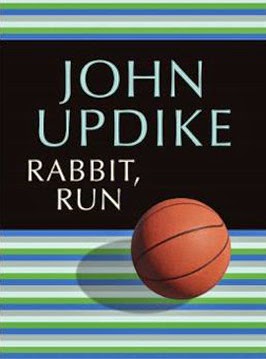
Rabbit, Run
Harry "Rabbit" Angstrom feels trapped in what he considers a second-rate life. His job, selling a kitchen gadget at a display table inside alternating local grocery stores, isn't going anywhere. His wife, who is pregnant with their second child, is what he describes as a mutt. His apartment is unkept, messed by a 2-year-old son whom he loves but is never picked up by a wife who is most often drunk.

It wasn't always this way for Rabbit, which is what makes his current situation so difficult to endure. He used to have a first-rate life as a star basketball player in high school. He set records.

The full weight of it hits him especially hard one day after coming home. The house is a wreck. His wife is drunk. His son has been shuffled off to grandparents. The car was inexplicably left behind. And the only person who seems to make sense is on the flickering picture of his failing television set.

"Know thyself, a wise old Greek once said. Know thyself. Now what does this mean, boys and girls?  It means, be what you are. Don't try to be Sally or Johnny or Fred next door; be yourself." — Mouseketeer Jimmy, Mickey Mouse Club

Who is Rabbit? He didn't really know anymore, but it certainly doesn't have much to do with the unbearable life he had been trapped into living. He decides to escape it and leave it all behind.

Initially, after telling his wife he wanted to get the car and pick up their son, Rabbit heads south. His impulsive idea is to find himself on a Florida beach. He gets lost instead, making it only as far as West Virginia. So he decides to turn back, but doesn't intend to go home.

PennsylvaniaHe visits the one person in Mt. Judge, Pennsylvania, who believes in him. Marty Tothero is his old basketball coach and the one person Rabbit expects will see him for who he is or maybe who he was.

Rabbit also expects Tothero to be somewhat sympathetic to estranged relationships. Although he stays with his wife, Tothero is notoriously unfaithful. He is sympathetic and dotes on him like a son, but is unsure how to help. He alludes to telling Rabbit to go home but takes him out on the town.

The two of them travel into the city and meet up with two girls. One of them is Ruth Leonard, a part-time prostitute of sorts who is overweight and aging, who hits it off with Rabbit. Rabbit hits it off with her too. And after making a point-by-point comparison between her and his wife, he decides to return the car to his wife and move in with Ruth.

The close proximity of his new residence, impending birth of his daughter, and the pursuit of the local Episcopal priest Jack Eccles frequently leads many to assume that the story is about the faith, love, or marriage. While those themes exist, the story is really about the emptiness people feel inside themselves and the devices they choose to fill it.

As a result, it often paints Rabbit as an anti-hero and someone to easily hate. But John Updike is a better writer than to make it so obvious. All of the characters, much like living and breathing human beings, feel an emptiness at their cores. Rabbit seems to be the only one who seems incapable of filling it. And for that reason, more than any other, most people want to punish him just like most of the characters in the book. Updike might as well have called this classic We All Have Holes.

A couple graphs about John Updike. 

John Updike
Probably best known for Rabbit, Run and the series that followed, Updike's character study and the highly distinctive prose he chose to tell it remains an extraordinary mark on American literature. Once exposed to this wry and intelligent voice, it is as difficult to forget as an echo.

Updike himself was inspired to write by his mother, who struggled to become a published writer. After graduation from high school as co-valedictorian and class president, he was fortunate enough to attend Harvard.

He graduated in 1954 and enrolled in the University of Oxford with a new ambition to become a cartoonist. When he returned to the states, he contributed to the New Yorker instead.

Rabbit, Run by John Updike Shakes A 9.9 On The Liquid Hip Richter Scale. 

The novel is nearly perfect in every imaginable way as Updike manages to make an antagonistic protagonist accessible enough that readers not only feel sympathetic for the lout but also miserable for it. What is remarkable and significant about these emotions that he so adeptly conjures out of his readers it that he largely presents them as a mirror that only masquerades as someone so distant.

Rabbit, Run by John Updike is available on Amazon. The novel can also be ordered for iBooks or as an audiobook from iTunes. The latter is narrated by Arthur Morey who brilliantly fits Harry "Rabbit" Angstrom like the shirt he didn't want to wear. Rabbit, Run can also be ordered from Barnes & Noble.

Thursday, October 10, 2013

Javier Marias Temps The Infatuations

The Infatuations
Every morning before work, María Dolz stops by the same café in Madrid. She has her coffee and breakfast there, easing herself into another day in the publishing world.

She has to ease herself into it. Authors are known to have egos and often expect outlandish things from their publishers, like a couple of grams of cocaine. The request, of course, is for research purposes only.

Dolz might be indifferent to some authors, but she doesn't wear blinders at breakfast. She is keenly aware of the people around her, especially those who also make the café their daily starter.

In fact, there is one couple in particular in which Dolz has taken an interest. The pair seem to be the perfect couple, living an unblemished life that lifts the spirits. It gives Dolz hope, a glimpse into two lives that aren't subjected to the same routine and doldrums of her existence. Miguel and Luisa Desvern are perfect until the end.

The end is quick and brutal for Miguel Desvern. 

While it would be days before Dolz would learn it, the last time she would see Miguel Desvern alive was the last time his wife would see him too. Shortly after leaving the café one morning, he would be stabbed to death.

The next time Dolz would see him would be in the newspaper, where he would be laying in the street with his shirt half off. She wouldn't even recognize him with his more usual old-fashioned elegance gone, wiped away by the spontaneity of a mistaken attack. Later, she would imagine that he would have never wanted to be seen in such a way — the victim of an accidental murder in Madrid.

The Infatuations
If proximity alone breeds familiarity, then this might well explain why Dolz decided to approach Luisa Desvern after learning about the attack. In her mind, though significantly less than the wife, they had both lost something. Luisa Desvern lost her perfect husband and Dolz lost her perfect couple.

Strangely but not unexpectedly, Dolz learns that the couple had indeed noticed her as part of their morning routine. They even had a name for her. She was known as the prudent young woman.

But all that would change soon enough as Lusia Desvern befriends Dolz for a day, making her someone in whom to confide about the spiraling, out-of-control thoughts and feelings she had since his death. There are some days she mourns the loss. There are some days she wonders what he thought in the final minutes. And there are some days she wonders if she can ever be the same person again or if that person only existed as long as her husband was in the world.

The chance encroachment might have ended with that whirlwind awkward meeting, but Luisa Desvern invites Dolz home and introduced her to a few friends. One has a suspected infatuation with the widow, but that doesn't stop Dolz from dating him, a decision she later regrets after overhearing something about the murder of Miguel Desvern.

A few graphs about Javier Marias and his prose. 

Javier Marias
Although Javier Marias began writing at an early age and was only 17 when he wrote his first novel, it would take several years before his work gained significant attention. So he simultaneously entered the literary world as a translator and won a Spanish national award for one of his efforts in 1979.

The award began to open more doors, including his work as a lecturer on Spanish literature and translation at the University of Oxford. And later, he continued to write until his work gained a foothold in the English market. The Infatuations, specifically, was published in Spanish two years ago before being translated by Margaret Jull Costa.

The novel itself is substantive, with Marias contemplating loss, life, relationships, and how quickly the past can evaporate from having any bearing on the present. But this doesn't necessarily mean the prose is always easy to embrace.

The Infatuations By Javier Marias Draws In 6.2 On The Liquid Hip Richter Scale. 

Dolz, whose perspective tells the story after the fact, has a habit of adding what this or that or maybe this or maybe that might mean — often in mid-sentence to provide a look at her logical but rambling mind. As a character study, perhaps it works. But it also creates a barrier to appreciate some of the author's finer points. Its a great story that brushes up against an exhaustive subject, but expect to work a bit.

You can find The Infatuations by Javier Marias on Amazon. The novel can also be downloaded for iBooks or the book can be ordered from Barnes & Noble. The audiobook is narrated by Justine Eyre, who has the right voice but mostly delivers the book at one brisk speed. The story doesn't begin to even out until the end.

Thursday, September 13, 2012

Peter Heller Charts Out The Dog Stars

The details of the super flu that ravaged humanity are never flushed out, but that hardly matters in Peter Heller's debut fiction novel The Dog Stars. The post-pandemic novel fully realizes its principal character, one of the few survivors trying to stay alive in an unforgiving and savage world.

Hig survived the flu that killed everyone he knew, except his fiercely loyal dog Jasper. Now, nine years later, he has settled into what has become a new normal that doesn't sit well with him. His only human friend, a mysterious survivalist named Bruce Bangley, seemed better suited for it.

Bangley's resolve is firm. Never negotiate. Kill anyone who comes within a half-mile. No questions. No apologies. No guilt.

The Dog Stars is a literary gem about humanity and hanging on to being human.

Hig and Bangley have staked out a small country airport and training field, surrounded by a small housing development similar to a golf course community. Hig had gravitated to the airport because it is where he kept his cream and blue 1956 Cessna 182, which he affectionately called "The Beast."

Bangley just showed up one day with a truck and an arsenal. His most used is a .408 CheyTac sniper rifle. Hig has an AR-15 semi-automatic rifle, fitted with a night scope. Bangley brought much more with him than a few rifles. He could arm a small company.

Despite only having each other, the relationship is strained because Bangley is untrusting, short-spoken, and not looking to forge any attachments. They have an arrangement instead. Hig flies his plane around a 30-mile perimeter, sometimes dropping rocks with notes on them to warn people away. "Turn Back South Or Die" and "Turn Back North Or Die," they read. Bangley kills people.

Hig contributes in other ways too. He maintains a small garden, takes hunting trips, and occasionally goes fishing despite Bangley's insistence it is a waste of time or "recreational." For Hig, however, the trips are therapeutic, a means to fight off his chronic sadness, isolation, and guilt over killing people.

They have little choice. Most of the people left aren't nice. When they see an airport off in the distance or a light in the night, they only see a potential source of water, fuel, shelter, sustainable power, and maybe food. The few times Hig tried to give people the benefit of the doubt, he was nearly killed.

The unexpected, infectious qualities of a deeply visceral novel.

With the exception of his now aging dog Jasper, Hig is largely on his own despite their shaky alliance. The only other contact he has is with a small community of Mennonites who live about 10 miles away from the airport. They survived the flu, but have since became infected with a blood disease that came afterward.

Hig visits them time to time to trade seeds and supplies, but has other reasons too. He longs for companionship and the ability to show compassion. He misses morality and humanity. He desperately wants someone to prove Bangley wrong and find someone who just isn't out for themselves.

Much of the visceral novel is like that, plodding along with its poetic and haunted internal struggle. The ramblings frequently come across as a memoir written by a survivor and discovered years later. So while the book does paint a vivid description of a post-pandemic world and a planet attempting to shake off global warming, it could just as easily stand on its own without the fracture of civilization. However, making it what it is brings something else to bear throughout-- several tense and suspenseful contacts.

It's surprisingly touching too. Even when events prompt Hig to chase down a random radio transmission he once picked up from Grand Junction, Colorado, both men recognize how important they have become to each other, like two brothers from different generations with nothing else in common except living together for nine years.

The realization sets in because in order for Hig to investigate Grand Junction, he has to fly beyond his point of no return. And even if there are survivors who don't kill him, there is no guarantee they will have unspoiled or additive-laced fuel for Hig to fly back.

A brief about author and adventure writer Peter Heller. 

Peter Heller is no stranger to the subject matter despite the fictional setting. He has years of experience as a veteran adventure writer, working for NPR, Outside magazine and National Geographic. Many of his previous books provided captivating glimpses of survival, including trips to Antarctica and Tsango Gorge in southeastern Tibet.

There seems to be little doubt that although he accompanied others on these excursions, the solitude and scarcity of resources of such extreme areas contributed to his ability to capture such deep self-reflecton and an appreciation for capturing breathtakingly physical visuals. In other words, The Dog Stars feels more real than made up in coming to know a man who is forced to survive in solitude.

The Dog Stars By Peter Heller Shines 9.1 On The Liquid Hip Richter Scale.

Named The Dog Stars because Hig had made up new constellations to replace those he had forgotten, every stitch of it is a complete and purposeful character portrait about a man who regrets the way he has to live while remaining hopeful despite despair. While originally concerned that the desolation and introspection would eventually run out of fuel, it wasn't long before I found myself wishing the book wouldn't end.

The Dog Stars by Peter Heller is available on Amazon. The novel is also available at Barnes & Noble and can be downloaded for iBooks. The contribution by Mark Deakins as narrator of The Dog Stars audio version goes beyond memorable as Hig, Bangley, and other characters. Deakins not only captures the voice of Hig, but also his state of mind.

Thursday, January 19, 2012

Nevil Shute In The Wet For 60 Years

For most people who read the book when it was published in 1953 (written in 1952), In The Wet by Nevil Shute Norway (aka Nevil Shute) was a provocative, controversial, and sometimes overreaching story in its attempt to be speculative about the British Commonwealth. And being so overtly critical of England's future, some of the early negative reviews were probably unfair.

Shute always considered In The Wet one of his better books. And he probably considered it as such because the book tackles topics such as democracy, socialism, and racism. He does so enough that some might find it equally provocative and controversial today. But in terms in being speculative, it'd be more likely to come across like an oddly crafted alternative reality, as his future is set in 1983.

The two interwoven stories in the foreground of In The Wet. 

The book opens with narrator Roger Hargreaves, an aging priest who is assigned to a remote area in the Australian outback in the 1950s. The portrait he paints is remarkably vivid in that it captures a stark and unforgiving landscape almost parallel to what one might expect in the American West some 50 years prior.

It is in this harsh and unforgiving environment that Hargreaves meets Pisspot Stevie (Stevie Figgins), the area's most infamous drunk who spends a good portion of his time hustling pints in town or disappears for days to see Liang Shih. Shih, among other things, grows his own opium in the bush.

Still, Shih proves to be a good friend. When Stevie becomes deathly ill, he looks for help. And when no one else is available to accompany Sister Finlay to aid Stevie, Hargreaves insists on accompanying her. The three of them set out across the flooded landscape together.

When they do arrive, Hargreaves spends considerable time with Stevie, expecting to give him his last rights. And it is during his final opium-soaked hours that Stevie begins to tell Hargreaves about his life, but not the one he lived. The next one he will live.

The substance of science fiction to explore social commentary. 

David Anderson is an Australian pilot who is assigned the Queen's flight team. In the forefront of this story is Anderson's relationship with a young English girl who works as an Oxford-trained secretary for the Queen. While it is a courtship story that slowly develops as the romance is placed on hold for the good of the Commonwealth and the Queen, it's obvious Shute brought the couple together so they can compare and contrast their respective countries.

In Shute's world, the United Kingdom has suffered an economic crisis caused in part by a socially driven exodus as the country became both more socialistic and adversarial toward the Royal Family. The crisis itself seems to have occurred in three parts over a span of 30 years.

The population, which still relies on World War II rationing, used democracy to continuously vote for a higher standard of living at the expense of entrepreneurial opportunities. The loss of these opportunities sparks a mass migration to America, Australia and, to a lesser extent, Canada.

Young men and women, he describes, decide to place more faith in liberty and individual ability to succeed than in the government's ability to keep people secure in their respective stations. The mass exodus compounds the economic weakness with a collapse of the housing market (which the government assumes).

Australia, on the other hand, embraces rugged individualism and an alternate democracy, which grants people multiple votes based on their contributions, e.g., one vote plus an additional vote for military service, a college degree, living abroad, raising a family without divorce, etc. The intent was to elevate the quality of the people in government rather than those who cater to a wanting majority.

The contrast between the two fictionalized futures exists, but the storytelling is never mired down by it. 

Perhaps even more interesting is that Anderson is a "quadroon," which means his mother was "half caste" Aborigine. Shute doesn't create a world where racism has disappeared, but Anderson disarms people by embracing it. He adopts the nickname "Nigger" even though no one would be able to tell by the color of his skin.

Some people might be offended by its usage, but Shute is pretty clear in his intent. He wanted to show two-fold that people of color are as good as anybody else and that even a quadroon born in a ditch can not only grow to become self-made but also to be the hero of the story in action and romance. Shute was well ahead of his time.

In The Wet By Nevil Shute Flies To 6.2 On The Liquid Hip Richter Scale.

In The Wet sometimes gets mixed reactions for its unapologetic layering of social commentary, but it's not a plea to embrace Shute's socio-political fantasies. Anyone could easily place more weight on the reincarnation story with a pastor attempting to reconcile it or the light romance between two people during political strife. More than that, it is effortless storytelling despite its complexities.

Then again, it might be some Americans without any understanding of the Commonwealth (and the ability to separate fact from fiction) will find some sections tedious or alien. Personally, I think Shute possesses a literary talent to keep it moving, but not everyone will. This isn't an intense story (even an assassination attempt is overtly calm), but it does fully realize the characters and a future of the author's making.

In The Wet by Nevil Shute is available on Amazon. You can also find the book at Barnes & Noble. iBooks also carries In The Wet and iTunes carries an audio version, read by Norman Dietz. Dietz breathes a fresh pace into the story, but as a decidedly young Hargreaves. He makes a better Anderson.

Friday, January 14, 2011

Kevin Guilfoile's The Thousand Measures Up For Pythagoras

The Thousand
Pythagoras of Samos (570 B.C. to 495 B.C.) was a mathematician and scientist best known for providing Greeks with the Pythagorean theorem in geometry and algebra. But he was also a philosopher (the first to call himself one) who eventually established a university (some call it a religious sect) on the island of Croton, a Greek colony in southern Italy.

There are ample mysteries surrounding Pythagoras, including that he was not a mortal man but rather a god who had taken human form to instruct the human race. Others say he was a demigod, a son of Hermes or Apollo. It is easy to understand why, given his extensive studies and contributions to geometry, music, and astronomy.

At the core of these contributions, Pythagoras linked them all to mathematics and the secret significance of numbers. Even after 2,500 years, philosophers from all over the world have been unable to unlock the remnants of his lexicon, mostly because much of which he taught was never written down. His disciples committed it to memory in order to keep their secrets.

Pythagoras provides the foundation for The Thousand by Kevin Guilfoile

Although Kevin Guilfoile only scratches the surface of Pythagoras, it does serve as the foundation for his thriller, setting heroine Canada Gold (Nada) at the center of a civil war between two factions of a secret society, modern day remnants of the Pythagoreans. One faction wants to expand the teachings. The other wants to preserve its purity and all of its secrets.

PythagorasAt points it almost seems a shame that Guilfoile offers no real astute details about the fictionalized factions and their secrets, but the book is still entertaining in the partial pursuit of a reconstructed ending for Wolfgang Amadeus Mozart's famed Requiem. The new completion, apparently using Pythagoras's teachings, was completed at the hands of composer-conductor Solomon Gold, Canada's father.

He is murdered early in the book, apparently as an act of revenge, shortly after being acquitted of the murder of a violinist in his orchestra, with whom he was having an affair. With the loss of Gold, so is his masterwork, the completion of the Requiem.

However, the pursuit of the Requiem is only a partial quest. The other pursuit is of Canada herself, ten years after the death of Gold. She seems to target of the competing factions because of her relentless interest in her father's case and for a neurotransmitter implanted in her head to curb seizures. The device does more than cure seizures; it provides her with a de facto mental acuity, photographic memory, and potential to unlock Pythagoras's secrets.

For the most part, Guilfoile does a fine job building a story with an interwoven conspiracy and the extent people will go to profit from or protect such secrets. However, the primary driver of this novel better parallels an adventure crime thriller than the greater effort of more popular legend-based thrillers.

The writing struggles frequently, with rough transitions and chapter openings that leave readers guessing whose point of view they have adopted. It's a curious issue, sometimes creating the daunting task of rereading every chapter opening with a different perspective once you know which character's eyes the author has loaned. Another annoyance is the constant swapping back and forth of characters' first names and last names for no reason whatsoever, even on the same page.

About Author Kevin Guilfoile.

Guilfoile is an American novelist, essayist and humorist. His first book tapped his humorist skills by creating a scrapbook parody about President George W. Bush. Four years later, Guilfoile shifted toward more serious subjects with Cast of Shadows, a thriller that takes place after cloning has been legalized in the United States.

Guilfoile is a fine writer, but still seems to lack the literary prowess and discipline to translate imaginative stories into masterful works. Still, The Thousand is entertaining and memorable, with elements that raise interesting questions for exploration.

The Thousand By Kevin Guilfoile Measures A 2.9 On The Liquid Hip Richter Scale.

It's easy to understand why some readers become frustrated with The Thousand. It's a good story, but makes it all too obvious that it wants to be much more than the final work delivers. The coolness comes from the reintroduction of the Pythagoras mythos and treatment of some supporting characters as adventure heroes, especially Canada's courtier Wayne Jennings, who is the only character in the book to escape a queer self-fascination and self-interest with himself (or herself).

The Thousand by Kevin Guilfoile is available on Amazon. It's a decent, although thinner, placeholder between the next novels by authors like Michael Crichton and Dan Brown.