Showing posts with label Crown. Show all posts

Friday, September 7, 2012

Belinda Carlisle's Lips Are Unsealed

Most people remember Belinda Carlisle as the cute, bubbly lead singer in the Go-Go’s. Not so many know about her punk roots, eating disorders, years of self-doubt, and three decades of substance abuse.

Within Lips Unsealed: A Memoir, Carlisle tells it all. She shares her story from her poor and humble beginnings to an unexpected meteoric rise to stardom, and her subsequent free fall.

Lips Unsealed: A Memoir.

In 1958, Carlisle was born in Hollywood to parents who had a 20-year age difference. At the age of five, her family moved to Thousand Oaks, Calif. Her dad operated a carpet cleaning business and was always on the road.

When he was home, her parents would fight and money was tight. She recalls how she and her siblings sometimes ate "oatmeal and Bac-O-Bit sandwiches for dinner." When he wasn't home, Belinda’s mother sought out the companionship of their neighbor Water Kurczeski.

Although he was described as her mom’s “special friend,” Kurczewski was a constant presence in their lives. Even when the family moved to Simi Valley, Reseda and then to Burbank, Kurczewski moved too. Nobody came out and told Carlisle the truth. Her parents had split.

When she did finally learn it, it was nearly impossible to get over the pain of abandonment. Her mother found herself on meds and her stepfather preferred spending his paychecks on booze.

Carlisle also remembers the physical and mental abuse. And at school it wasn't much better. She was teased for having only one outfit and for being slightly overweight. Some kids called her Belimpa.

As she grew into her teens, Carlisle was slowly drawn to the burgeoning Los Angeles punk music scene. While working as a beautician and secretary, her first stage stint was as the drummer for The Germs.

The Go-Gos set Carlisle straight to stardom.

It wasn't long after she would found the Go-Go’s with guitarist Jane Wiedlin. Despite continuing to struggle with weight and drug experimentation, she easily recalls the band’s earliest days as their sound evolved from punk to pop rock.


Eventually, after the lineup included Kathy Valentine, Charlotte Caffey and Gina Schock, the band discovered what worked for them. People wanted catchy songs and fun personalities — a formula that help them become the first all-female band to ever have a #1 album while writing their own songs and playing their own instruments.

MTV certainly helped too. They became music video darlings for songs like Vacation and Head Over Heels. But what these videos didn't show was anything behind the scenes. Carlisle became a bonafide party girl and hardcore cocaine addict. The Go-Go's were nearly over.

It was after the split that Carlisle met and married producer Morgan Mason (son of actor James Mason) and began a promising solo career. Her first album, Belinda, turned gold. Her follow up earned super stardom with Heaven Is A Place On Earth, I Get Weak, and Circle In the Sand.

While Carlisle continued on her rapid rise, she was also working toward her demise, alternating between addiction, depression, and her eating disorder. She got clean while pregnant with their son, James Duke Mason, but then spiraled back into substance abuse immediately, even after she and Mason moved to the south of France.

She hid her addiction from Mason for the most part, and it was easy to indulge since she was always on tour. It took a near cocaine overdose, alone in a hotel room, to seek out help.

Lips Unsealed By Belinda Carlisle Rolls In With 6.3 On The Liquid Hip Richter Scale. 

Amazingly, Carlisle does eventually come to terms with many of her personal demons and Mason has managed to stick by her (even when she posed for Playboy at the age of 42). While the book finishes on this hopeful note, the more engaging moments are all early on — her childhood and early punk days (with no fear in naming names).

Lips Unsealed: A Memoir by Belinda Carlisle is available on Amazon. You can also download the book from iBooks or (as I did) listen to the very precise (almost too precise) diction as Carlisle reads the audiobook herself. Barnes & Noble also carries Lips Unsealed: A Memoir. Last night, I saw her perform live in Henderson, Nev. She looked healthy and happy, and her voice never sounded better.

Thursday, August 30, 2012

Jay Caspian Kang Brings Out The Dead

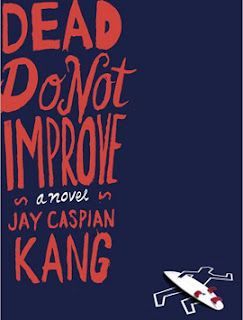
The Dead Do Not Improve
If you are looking for one last summer read, Dead Do Not Improve by Jay Caspian Kang will leave you bemused if nothing else. Not a stitch of it makes for great literature, but it is smart and satirical with frequently funny commentary that masquerades as a neo-crime noir. Some people will love it. Some people will hate it. But it won't likely disappear into some forgotten pile of dust.

Maybe it's to be expected. Kang is an editor at Grantland, a pop culture/sports site where the storytelling is often more important than the story. This loopy romp around the Bay Area has the same sort of voice.

The story is fiction, with some heavy-handed navel-gazing by Kang. The similarities between him and the principal character — recent MFA grad Phillip Kim — are almost nonexistent beyond a few swapped facts and experiences, including a shared fascination with Cho Seung-Hui that ends (or perhaps begins) in bewilderment. But that's not the story. The story is about all sorts of strangeness.

Dead Do Not Improve is freshly entertaining and wildly wonky. 

It opens with Kim missing the possibly random and senseless killing of his neighbor, an aging underworld denizen, the night before. He doesn't even learn about her death until he Googles himself out of boredom the next morning.

surfAfter he discovers the killing, he starts obsessing over the proximity — bullets cutting through his apartment complex while he slept. It could have easily been him who was hit, but it was Dolores Stone aka "The Grey Beaver" instead. He had spoken to her twice: Once she had borrowed four eggs; another time, she asked for cigarettes. He gave her five.

His fascination with her death takes hold all the more as he discovers her career link to the seedier side of San Francisco. Friends tell him to brush it off, but there isn't much in his life to distract him. His job is best described as an incessant reminder that he was a failed creative hack.

Every day, he sorts through company emails from new clients, men who had recently suffered a breakup and needed coaching to help them get over it. He is supposed to write personal messages, but has found it much more satisfying to plug in his prewritten responses. Cut, paste, and tweak like Adlibs.

While Kim thinks in perpetual whimsy, Finch surfs up the punch.

Since the clever but passive wallflower Kim is not enough to drive the story despite his self-loathing and humorous anecdotes, Kang leans on Siddhartha "Sid" Finch aka "Keanu," a surfer turned homicide detective assigned to investigate the case with his "potato head" partner Jim Kim. Mostly, Finch comes across as a pragmatic beach drifter who happens to have a badge.

It doesn't take long before he discovers a connection between Kim and Stone that neither of them knew. Kim's company and Stone have been targeted by an ultra-fanatical subculture of militant organic cafeteria owners. It's a collective of employees who have cooked up a plan to thin the growing schools of pariahs who feed off dupes on the Internet and in San Francisco. Then again, the killing could just as easily be errant gang violence.

Jay Caspian Kang
With two protagonists, Kang deftly allows latecomer Finch to follow leads while Kim begins to fear for his life and pursue a love interest. A cross sampling of his many insights include being Korean-American, the silliness of social media, memories of his father trying to prove that Bob Dylan was not overrated, and a sense of self-loathing instilled by the marketing efforts of companies like Whole Foods.

This is where the book works the best, with Kang infusing his personal perspectives and voice. He too was born to Korean immigrants and grew up in Boston and Chapel Hill. He attended Bowdoin College where he won the 2003 Sinkinson Prize for Best Short Story before being kicked out of school over his behavior.

Dead Do Not Improve Finds 3.6 On The Liquid Hip Richter Scale.

The real trouble with the novel is in pretending it has a crime story plot. While it does rub up with neo-noir, it only does so in an effort to provide a sense of purpose to the abundance of entertaining distractions and creative commentary. This doesn't make it any less enjoyable, but does make it less than cohesive. Likewise, Kang never promises nor does he offer any answers for his many subjects.

Knowing that before you pick up the book will likely deliver a better read. And as more people do, there is a good chance this will be one of those books that becomes a cult classic loved in future decades. Dead Do Not Improve: A Novel by Jay Caspian Kang is available on Amazon. You can also find the novel at Barnes & Noble or download it from iBooks. The audiobook is read by Feodor Chin, who delivers his own memorable take on the material.

Friday, January 28, 2011

Endgame: Bobby Fischer's Remarkable Rise And Fall

End GameIn the United States, chances are that Americans can name just one world class chess player. His name is Bobby Fischer, and he is widely regarded as the greatest chess player of all time.

Such acclaim doesn't always come freely as the title of the newest book on Bobby Fischer's life. Endgame: Bobby Fischer’s Remarkable Rise And Fall From America’s Brightest Prodigy To The Edge of Madness (Endgame) is exactly as it sounds.

The unlikely makings of a world chess champion.

When they were children, Fischer and his older sister taught themselves how to play chess. But as time went on, she grew bored with the game while he went on to read every book he could find on the subject. Then he ventured out into New York City to try his hand and absorb what he could.

Fischer’s mother, Regina, did what she could to introduce her son to other hobbies and sports, and he was quite proficient at some (such as swimming and tennis). School studies were different. He was a mediocre student, thinking only of chess. His mother, perhaps sensing his brilliance, eventually helped to connect him with seasoned players who might take the boy under their wing or at least give him a challenge.

In a matter of just a few years, Fischer became a chess master.

In Endgame, author Frank Brady does an outstanding job chronicling Fischer’s life. He debunks many urban legends, myths and untruths while revealing a highly credible side of the chess champion that most never knew existed.

Fischer may have transitioned from the emotional kid who cried when he lost into a swaggering, confident champion, but hidden behind the brilliance and confidence were a slew of insecurities and eccentricities. These would be his downfall.

Fischer could be kind, but he could also be cruel, casting people out of his life if he felt they had betrayed him or if he felt threatened in any way. He also had no hesitation in making outrageous demands of tournament organizers, asking for far more money than what the prize purse might have been, free hotel accommodations, specific lighting, specific chairs.


What sometimes looked like monetary greed might have masked a insecurity. For all the bickering he did to demand more prize money, he routinely turned down lucrative offers to lend his name to products and endorsements. He also turned down an opportunity to play for $5 million, a decision he surely regretted in later years.

It is almost impossible to understand why that as Fischer progressed, he became anti- American and anti-Semitic in his beliefs. But this growing hostility would eventually lead him to be jailed in Japan without a valid passport. He could no longer turn to the U.S. for help. He was wanted for tax evasion and violating international sanctions (for playing a tournament in Yugoslavia).

He was eventually released after being granted citizenship in Iceland. His health failing, Fischer died three years ago, pretty much alone.

A few moves about author Frank Brady

Frank BradyBrady is currently the chairman of the department of mass communications, journalism, television and film at St. John's University, New York. But prior to his position and teaching there, Brady was the founding editor of Chess Life magazine.

Although Brady went on to serve as editor of several major publications, his passion for chess led to him to become an international arbiter. He has also directed many major chess tournaments and served as secretary of the United States Chess Federation for two years. He has written several books and his previous Fischer biography, Bobby Fischer: Profile of a Prodigy, was a best seller.

Endgame by Frank Brady Checkmates An 8.8 on the Liquid Hip Richter Scale.

Another interesting note about Brady is that he was one of Fischer’s long-time friends. It's this interesting bit of trivia that makes his insight and understanding of chess and the culture surrounding the game an additional win for the book.

Brady was there, and when he wasn't there he earned enough experience in the game to provide a compelling read about it, as well as the interesting lives people lead behind it. As an additional point of interest, it reveals how different cultural backgrounds weigh heavily on shaping the play of the game. Sometimes it reads as if the players were competing in a boxing ring.

Endgame: Bobby Fischer's Remarkable Rise and Fall - from America's Brightest Prodigy to the Edge of Madness is available on Amazon on Feb. 1, 2011. This review is based on an unedited advance copy of the book from Crown.